


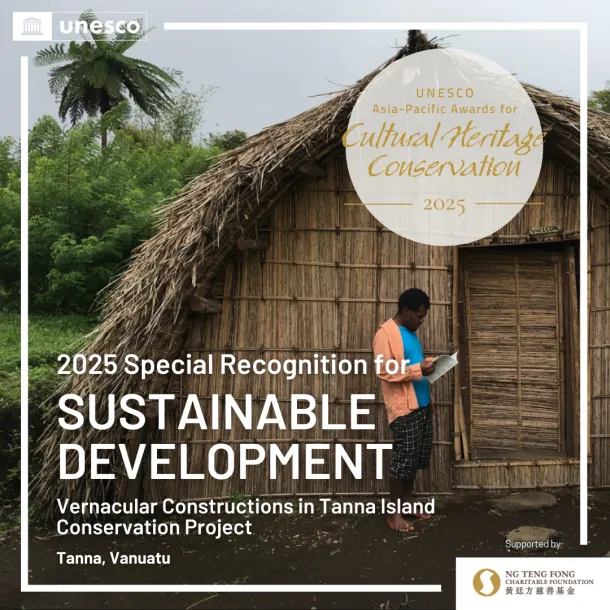
Vanuatu’s Vernacular Constructions Conservation Project on Tanna Island has received Special Recognition for Sustainable Development at the 2025 UNESCO Asia-Pacific Awards for Cultural Heritage Conservation. This marks the first time a Pacific Small Island Developing State has been recognized through this prestigious regional programme.¹
The project focuses on revitalizing the nimalatan, a traditional vernacular structure deeply embedded in Vanuatu’s kastom practices. Built entirely with local materials, the nimalatan is historically valued as a cyclone-resilient communal house that reflects generations of environmental knowledge and social cohesion.
The UNESCO Awards Jury described the project as “A compelling prototype for experimental and innovative heritage conservation, foregrounding nature-based intangible knowledge systems and traditional wisdom.” The project was recognized for its community-driven approach and integration of intangible cultural knowledge, prioritizing kastom building practices rooted in environmental stewardship, forest management, and intergenerational transmission of knowledge.
The project was a collaborative effort between local villages in the Middle Bush area and Kyoto University, revitalizing the nimalatan through participatory research, co-design processes, and prototype construction. Newly adapted nimalatans now serve as women’s centres, cyclone shelters, and communal meeting spaces, demonstrating how living heritage can evolve while maintaining cultural continuity.
Image Courtesy: UNESCO