




India’s USD 1 trillion real estate growth story will need more than just capital — it will need climate-conscious capital. Sundaram Alternates (SA), the alternatives platform of the Sundaram Finance Group, has released a white paper titled “Bridging the Gap: The Essential Role of Climate-First, ESG-Integrated Private Credit in India’s Real Estate Growth.”The study outlines how sustainable financing is fast becoming the key driver of long-term sectoral stability and investor value.
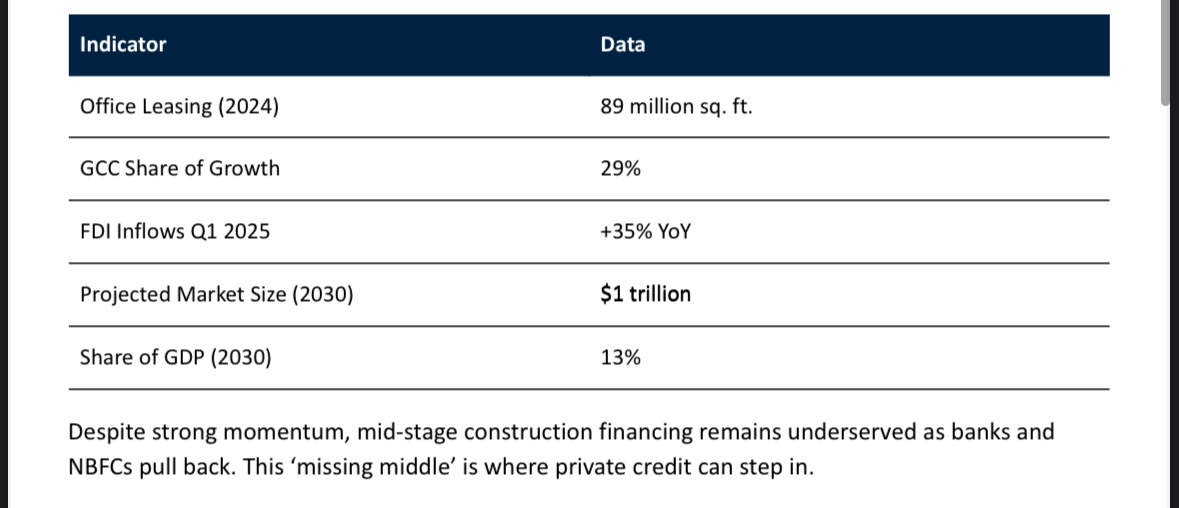
Closing the Mid-Stage Financing Gap
Despite record momentum — 89 million sq. ft. of office leasing in 2024 and a 35% YoY jump in FDI inflows in Q1 2025 — India’s real estate market faces a persistent void in mid-stage construction funding. As banks and NBFCs tighten exposure, private credit emerges as the bridge between liquidity constraints and growth ambitions. The paper identifies ESG-integrated private credit as the “sweet spot” for capital infusion, offering developers access to patient, purpose-driven funding while targeting 15–20% risk-adjusted returns for investors.
From Green Vision to Measurable Outcomes
With the built environment contributing nearly 40% of global energy-related CO₂ emissions, the sector’s climate responsibility is clear. The white paper stresses that embedding ESG principles from project inception is no longer optional. Real-world outcomes back this claim: 27,000 MWh in annual energy savings, 13.4 million m³ in water savings, and over 13 million sq. ft. of green-certified real estate delivered under SA’s climate-first approach — all while positively impacting over 1.3 million lives.
Global Momentum, India’s Advantage
Worldwide, ESG-led private credit is mainstream, channeling over $1 trillion into sustainable investments. With India introducing its green taxonomy and SEBI’s BRSR norms, the timing is ideal for a climate-first transformation in real estate financing.
“India’s real estate story is no longer just about scale — it’s about sustainability,” says Karthik Athreya, Managing Director, Sundaram Alternates. “Climate-first private credit is the missing link between investor capital and India’s real estate growth. This is a practical roadmap that combines disciplined risk management with measurable climate outcomes.”
Financing Growth with Responsibility
The white paper concludes that India’s real estate industry is at an inflection point. Sustainable growth will depend on a financing ecosystem that values not only returns but resilience. Climate-first, ESG-integrated private credit offers exactly that — capital that builds both assets and accountability.
By embedding sustainability into the heart of real estate finance, India has the opportunity to set a new global benchmark — where growth, governance, and green outcomes converge.