



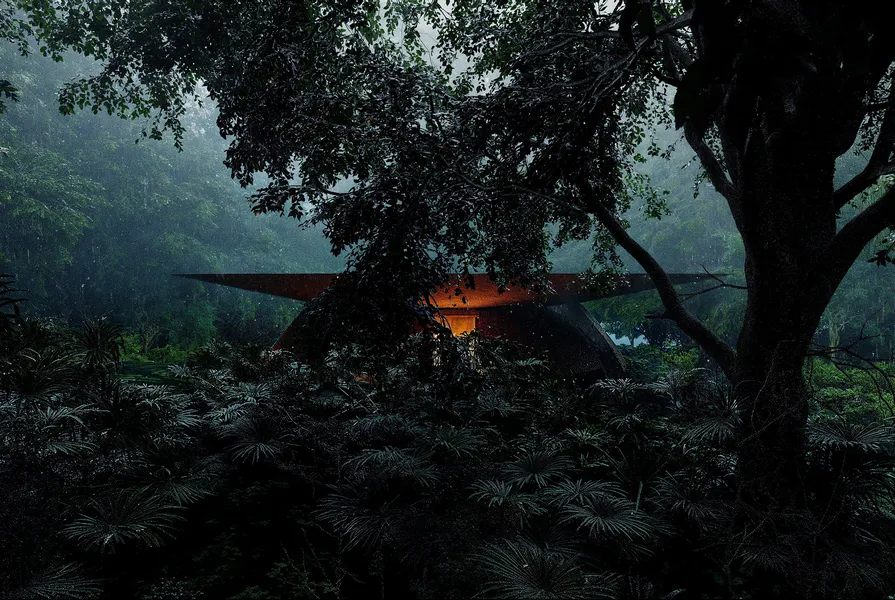
Melbourne-based architect and founder of Artefact Architects Steven Chu has won the Grand Prize in an international design competition to design a luxury villa on a Japanese island, with his winning proposal set to be realised and sold. Open to architects and creators under 40 years of age, the Not a Hotel International Design Competition 2026 invited participants to design a luxury villa for Yakushima Island, a subtropical island off the southern coast of Kyushu in Japan. The competition attracted more than 1,000 international entries across 112 countries. Chu’s proposal was shortlisted alongside ten finalists before being presented in Tokyo to a jury that included internationally renowned architects Sou Fujimoto, Bjarke Ingels and interior designer Masamichi Katayama.
Titled Sound of Rain, Chu’s winning proposal harnesses Yakushima’s extraordinary rainfall, up to 10 metres annually, to create an atmospheric and sensory architectural experience. A low and slender roof plane channels rainfall downward before capturing, filtering and reusing it, doubling as a water feature. Internally, a central atrium features a glazed oculus over which water pools, casting rippling light patterns across main living spaces below. The design treats rain not as a problem to mitigate but as a material to inhabit. By making precipitation visible and audible, the villa turns climate into an experiential amenity.
According to Steven Chu, the project reflects Artefact Architects’ broader interest in creating spaces that are culturally resonant and expand the experience of belonging within the setting. “I sought to create an architecture that could only belong on this site. And for the guests of this esteemed client of ours to inhabit rain and to inhabit the sound of rain,” said Chu. The statement underscores a site-specific approach where architecture responds directly to Yakushima’s hydrological identity. The island, known for ancient cedar forests and moss-covered terrain, is a United Nations Educational, Scientific and Cultural Organization World Heritage site. Designing for that context demands restraint and environmental sensitivity.
The project is currently in design development in collaboration with competition organiser Not A Hotel, a Japanese hospitality company that commissions architects to design high-end residences and retreats. Not A Hotel’s model commissions leading designers for limited-run villas that operate as part private home, part boutique accommodation. Winning entries move from concept to construction, with the finished property offered for sale to clients. This format gives emerging architects under 40 years of age a direct path to built work in premium locations. For Chu, it marks a significant international commission and a chance to test Artefact Architects’ atmospheric design strategies at full scale in residential architecture.
The jury’s selection of Sound of Rain highlights a growing interest in climate-responsive luxury. Rather than sealing interiors against weather, the villa curates exposure to it through controlled apertures and water collection systems. The glazed oculus functions as both skylight and shallow pool, mediating light and sound while feeding into the building’s reuse cycle. The low roof profile reduces visual impact on the landscape, while the central atrium organizes plan and section around the movement of water. Such strategies align with broader shifts in hospitality design where sustainability and narrative experience are key differentiators. Similar approaches can be seen in projects like water-driven designs in Japan.
The Not a Hotel International Design Competition 2026 drew over 1,000 entries from 112 countries, making it one of the year’s most competitive platforms for young practices. Past juries have included leading figures in contemporary architecture, and the promise of realization sets it apart from speculative contests. By placing Steven Chu alongside Sou Fujimoto and Bjarke Ingels in the final judging, the competition positions the winning scheme within a global discourse on context, climate, and luxury. The Yakushima site’s extreme rainfall becomes a generator of form, program, and atmosphere.
For Artefact Architects, the commission expands a portfolio of work focused on material presence and environmental attunement. The Melbourne practice has emphasized sensory qualities and site specificity across its projects, and Sound of Rain translates those interests into a subtropical island setting. As design development proceeds with Not A Hotel, the villa will test how architecture can frame natural phenomena without overwhelming them. Full details and future updates are expected via the Not A Hotel official website. The project confirms that emerging Australian architects are shaping international hospitality through grounded, poetic responses to place.