



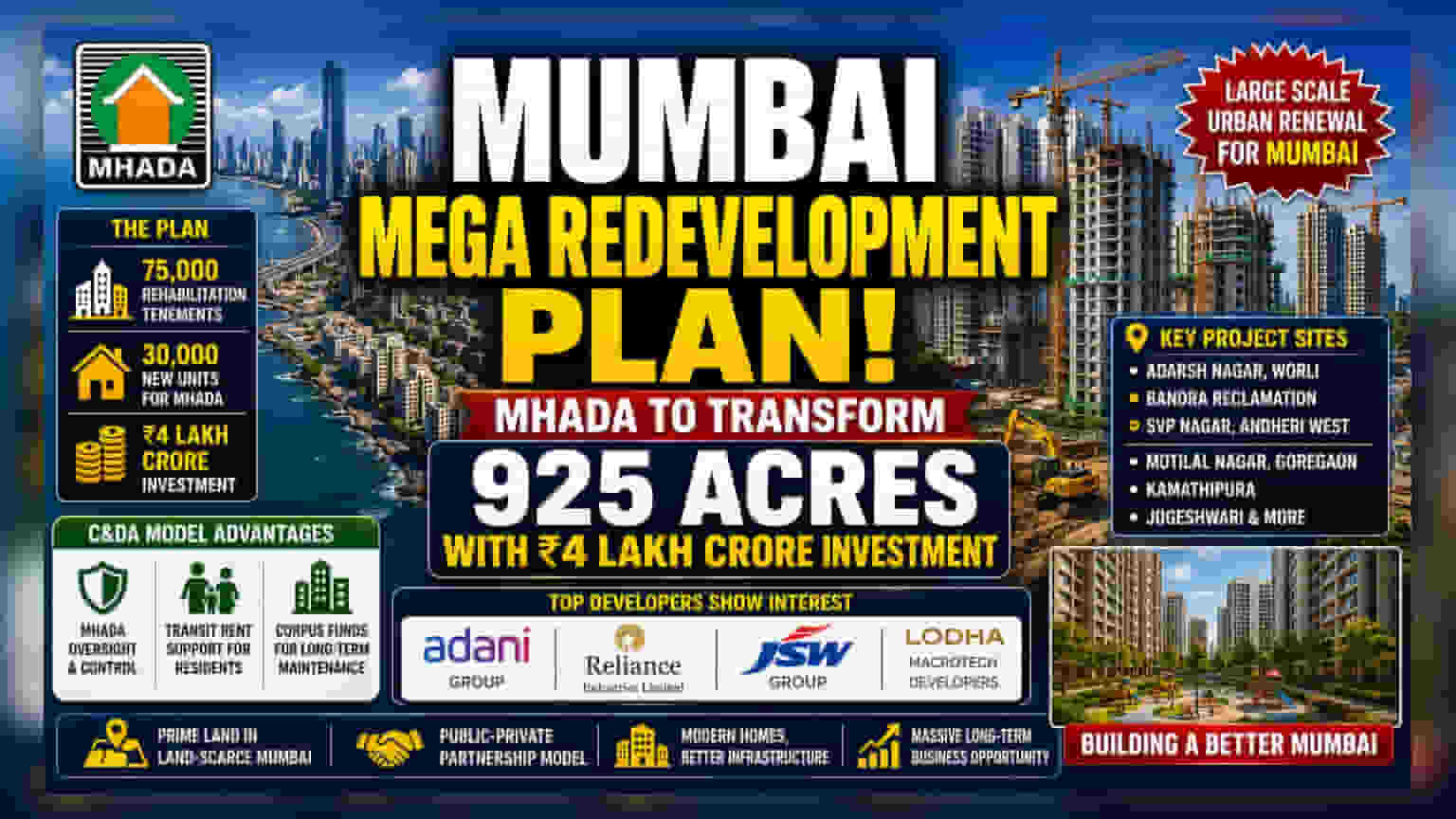
MHADA Mumbai Redevelopment is moving forward with a massive Rs 4 lakh crore roadmap spanning 925 acres across the city. The Maharashtra Housing and Area Development Authority announced the colossal urban renewal plan aimed at transforming aging housing stock into modern residential complexes. The project targets the construction of 75,000 rehabilitation tenements for existing residents and 30,000 new units for MHADA. Key project sites include Adarsh Nagar in Worli, Bandra Reclamation, and Sardar Vallabhbhai Patel Nagar in Andheri West. Other major areas like Motilal Nagar in Goregaon, Kamathipura, and Jogeshwari are also included in the pipeline.
Public-Private Partnership Push
This initiative marks a shift toward large-scale public-private partnerships in Mumbai’s real estate sector. By using the Construction and Development Agency model, MHADA aims to streamline the redevelopment process while retaining oversight. For private developers, this represents a significant opportunity to secure large, prime land parcels in a city where land availability is extremely limited. Major conglomerates and developers, including Adani Group, Reliance Industries, JSW Group, and Macrotech Developers, have already shown interest in the bidding process for the first set of projects. MHADA Mumbai Redevelopment is drawing attention from top-tier firms due to scale and location.
Unlike traditional developer-led redevelopment, where private entities often manage the entire process, the C&DA model places MHADA at the center of project management. This approach includes provisions for transit rent support—money paid to residents during the construction phase—and the creation of corpus funds for the long-term maintenance of new buildings. By keeping oversight within the government agency, the model seeks to protect resident interests, which has historically been a friction point in Mumbai’s redevelopment projects. The C&DA framework is designed to balance speed with accountability across all MHADA Mumbai Redevelopment sites.
While the scale of the investment is significant, redevelopment projects in Mumbai inherently carry high execution risks. Challenges such as delays in obtaining regulatory approvals, issues with tenant displacement, and potential legal disputes over property rights are common in the sector. Furthermore, for the participating developers, the ability to manage construction costs and adhere to strict timelines will be critical to maintaining profit margins. Investors in the real estate sector typically view large, multi-year redevelopment projects with caution, as cost overruns or legal hold-ups can pressure cash flows. MHADA Mumbai Redevelopment will need rigorous monitoring to mitigate these risks
What Investors Must Watch
The most important monitorables for this initiative will be the formal awarding of project contracts and the specific timelines for land handover. Investors should track how the government manages the transition for existing residents, as any delays here could stall construction. Additionally, monitoring the bidding outcome will reveal the competitive intensity and the financial burden developers are willing to take on for these projects, which will provide insight into the potential profitability of these long-term redevelopment ventures. Transparency in resident relocation and corpus fund deployment will be key benchmarks for MHADA Mumbai Redevelopment.
The project’s geographic spread covers some of Mumbai’s most contested and valuable real estate. Adarsh Nagar in Worli, Bandra Reclamation, and Sardar Vallabhbhai Patel Nagar in Andheri West represent high-demand micro-markets with proximity to business districts and transport corridors. Motilal Nagar in Goregaon, Kamathipura, and Jogeshwari add further scale and complexity due to dense existing settlements. MHADA Mumbai Redevelopment intends to replace deteriorated housing with modern infrastructure, improved sanitation, and planned open spaces while accommodating current occupants within the same footprint.
If executed as planned, MHADA Mumbai Redevelopment could redefine how urban renewal is delivered in land-constrained metros. The Rs 4 lakh crore outlay signals government intent to treat housing as infrastructure, using the C&DA model to align developer incentives with resident safeguards. Success will depend on timely approvals, dispute resolution, and cost discipline from private partners. For now, Adani Group, Reliance Industries, JSW Group, and Macrotech Developers are positioned as early contenders in what could become one of India’s largest coordinated housing revamps. The roadmap sets a precedent for other cities facing similar aging stock and land scarcity.
Image Courtesy: Whalesbook