



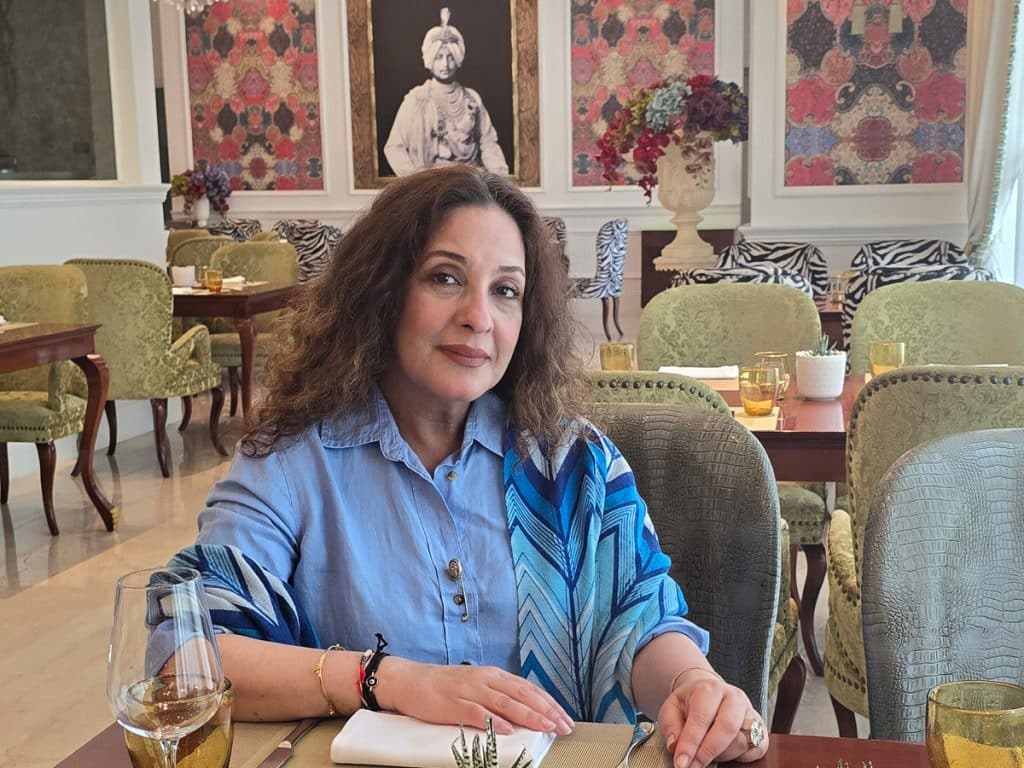
In an era of fleeting social media trends, independent interior designer Soni Aggarwal argues for a return to “well-balanced opulence,” crafting multi-sensory restaurants that prioritise ambience, tactile luxury, and a cohesive soul. In the hyper-competitive world of hospitality, restaurant design is a high-stakes discipline. It operates at the complex intersection of brand identity, operational efficiency, and pure sensory engagement. A successful space must do more than just look good on Instagram; it must function flawlessly, evoke a specific mood, and create an atmosphere that resonates long after the meal is over. We sat down with Aggarwal to deconstruct her design philosophy, from the psychology of a first impression to the critical, often-overlooked, role of tactile sensations.
The Primacy of Ambience Over Narrative
For Aggarwal, her projects begin with a feeling. “My first instinct is always to create a feeling of space,” she explained. “I am driven more by ambience than a narrative.” This approach dictates her foundational spatial decisions: a preference for high ceilings and open floor plans. However, “open” does not mean vacuous. The challenge is to foster a “buzz” while avoiding a “claustrophobic” or “overwhelming” environment. “In a restaurant, it’s important for customers to feel the buzz and be able to see lots of people,” Aggarwal noted. She achieves this balance by developing “alcoves or special areas” within the larger, open-plan, structuring the volume to fit specific needs like private dining rooms (PDRs).
The role of narrative, she clarified, is dictated by the concept. “Fine dining restaurants offer more opportunity for story-telling and unfolding a narrative,” she conceded. In contrast, “mid-level or QSR concepts are more about impact with a short story and some resonant features.” The common thread is that the story, when present, must serve the primary goal of creating an immersive atmosphere.
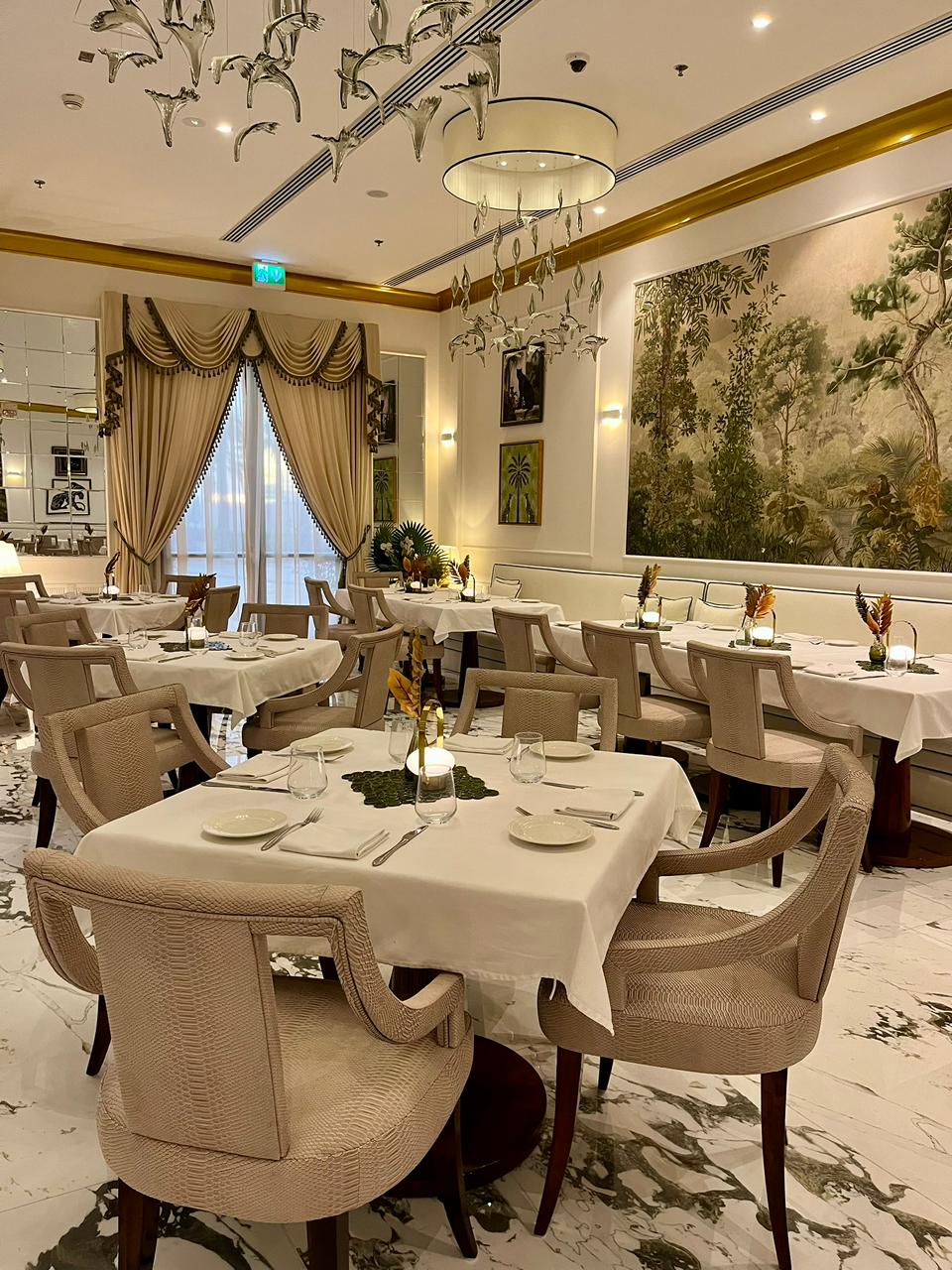 Weaving a Subtle Story at Punjab Grill, Ritz Carlton, Abu Dhabi
Aggarwal’s work at the Punjab Grill at The Ritz Carlton Grand Canal, Abu Dhabi, serves as a masterclass in this philosophy. The brief was to conceptualise a luxurious Indian restaurant, and Aggarwal saw an opportunity to weave a narrative that was both culturally authentic and deeply resonant with its location. “I wanted to use Indian symbols in a less stereotypical way,” she said.
The concept became “a royal retreat in the middle of a forest.” The theme was a strategic choice, designed as an antidote to the local climate. “I felt it would be very appealing in a hot, arid city to enter a lush, green, and airy atmosphere,” Aggarwal explained. The entire space became an immersive experience: stylised chandeliers emulate falling leaves, large-scale murals depict foliage, and even the floral arrangements focus on greenery.
The narrative elements are subtle, woven into the larger sensory story. “The lion is a repeating theme in my furniture and artefacts,” she revealed, “because it is a subtle reference to Maharaja Ranjit Singh, who was referred to as Sher-e-Punjab.” The bar area uses a lotus theme, “designed to emulate the beauty of a lotus pond: cool and dark, a place to relax and unwind.” The PDR is conceived as “a balcony view of the forest from the Royal lodge, a great place to introduce the peacocks in a more natural setting.”
The result is a space where symbolism isn’t just applied; it’s deeply embedded in the atmosphere. “Essentially,” she stated, “I wove all the symbolism subtly into a larger story.”
A Signature of “Well-Balanced Opulence” 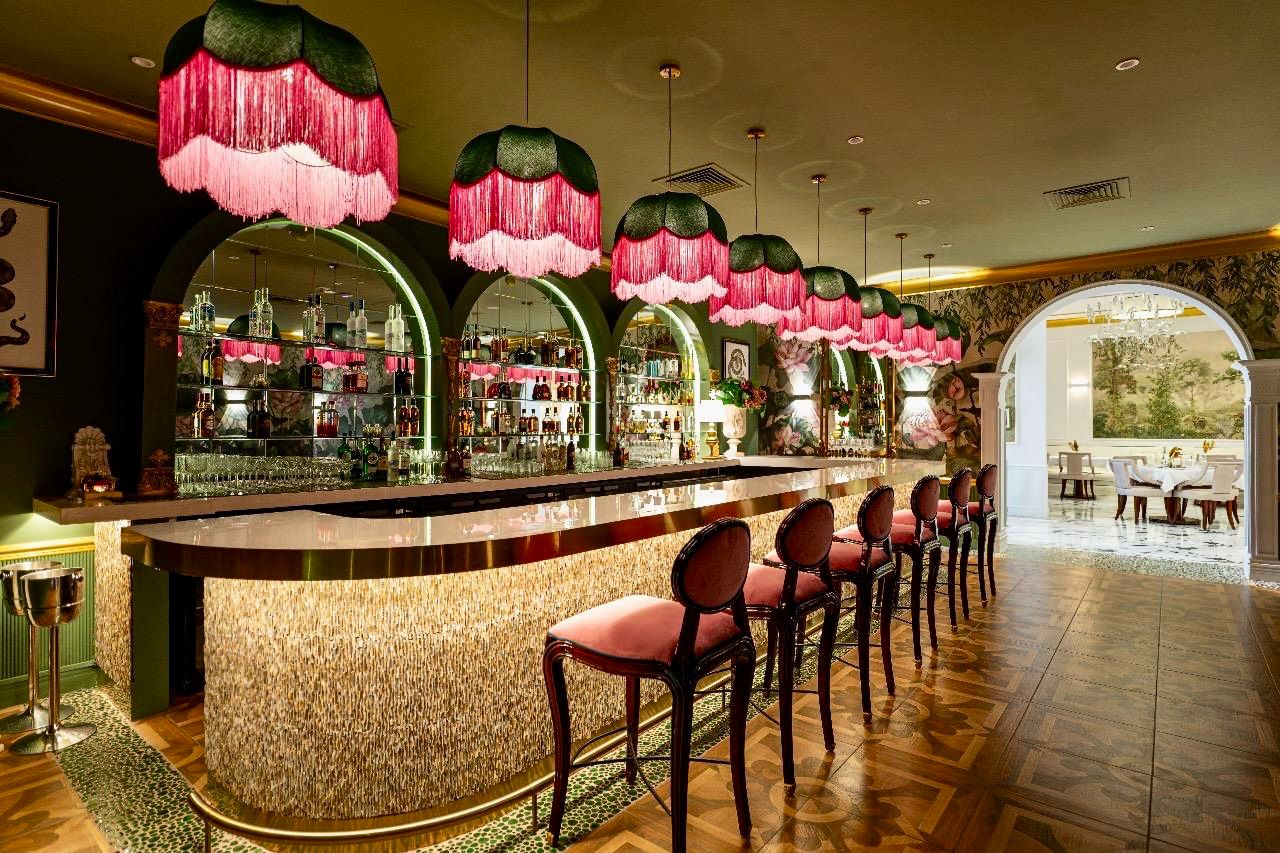
When asked to define her style, Aggarwal describes it as “varying degrees of neo-classical influences,” driven by a “definite preference for the British Private Members Club look and feel.” She added, “I believe that whether you live in a grandiose home or a simple one, when you step out, the restaurant has to offer you fantastic food, great service in a beautiful setting.”
Her color palette reflects this, drawing heavily from nature themes. “I tend to be drawn to nature themes and colours,” she noted, “I balance it with lots of creams and whites.” Her preference leans toward veridian tones and earthy colours.
Lighting is the final, critical element in achieving this signature intimacy. Aggarwal is a firm critic of overly bright spaces. “I do not like over-lit places,” she asserted. “There is a certain intimacy and living room feeling to low lighting and the clever use of lamps.” This approach, she observes, is aligned with a larger global shift. “When I travel the world, I see that the most acclaimed restaurants are veering towards classic interiors,” she said.
Seating, Sound, and Flow
Beyond aesthetics, a restaurant’s success hinges on its operational design. Aggarwal approaches the “psychology of seating” with a focus on absolute versatility. “A restaurant’s open areas should ideally be able to accommodate several layouts,” she advised. “I typically use 2 and 4-seated tables as my building blocks, as they can be added or subtracted to form the desired configurations.”
She also ensures the inclusion of varied seating types to cater to different guest needs, from sofa seating for “those who want to sit in absolute comfort” to comfortable bar stools. A trade secret for those trying to understand the psychology behind restaurant interiors, Aggarwal revealed, “I also try to fit in a couple of round tables, as they really are the best for cohesive conversations and usually get booked first.”
Acoustics, she argues, are just as important as the visual design, though they are often a project’s first casualty. “Too often our senses are assaulted by blaring music that makes any conversation virtually impossible,” she exclaimed.
Designing for All Five Senses
In the age of Instagram, it’s tempting to design for the camera first. Aggarwal resists this, arguing that true “Instagrammability” is a byproduct of a deeper, more holistic quality. “A beautifully anointed interior is authentic and Instagrammable, both can co-exist,” she said.
The reputation is built not just on visuals but on a complete sensory experience. For Aggarwal, the tactile elements are paramount. “If one aspires to create a fine dining experience, touch and even sound are paramount!” she stressed. She meticulously considers every touchpoint, “The sound your cutlery makes against the crockery as you eat, the feel of your table linen, the size of your cutlery, and how smooth it feels, it’s all subconscious and requires a great deal of attention to ensure no jarring element.”
This attention to detail extends to her styling process, where items are often eliminated if they don’t feel right. The goal is to ensure “every element feels seamless and pleasing to touch & use.”
The Antidote to “Soulless” Design
When asked about the biggest mistakes she sees in the industry, Aggarwal was candid. “If I were to be honest, I see a tendency towards soullessness!” She critiques the prevalence of sterile, uninspired spaces. “There are so many restaurants that look like boardrooms and conference rooms,” she said.
Her solution is a return to thoughtful, layered design. “Even minimalism has to be maximalised occasionally!” she insisted. This ‘soul’ is also found in sustainability, a practice she champions through upcycling and refurbishment. “I am a huge proponent of sustainability,” she said, noting that for many projects, “we really go the extra mile to give a new lease of life to as many elements as is possible.”