



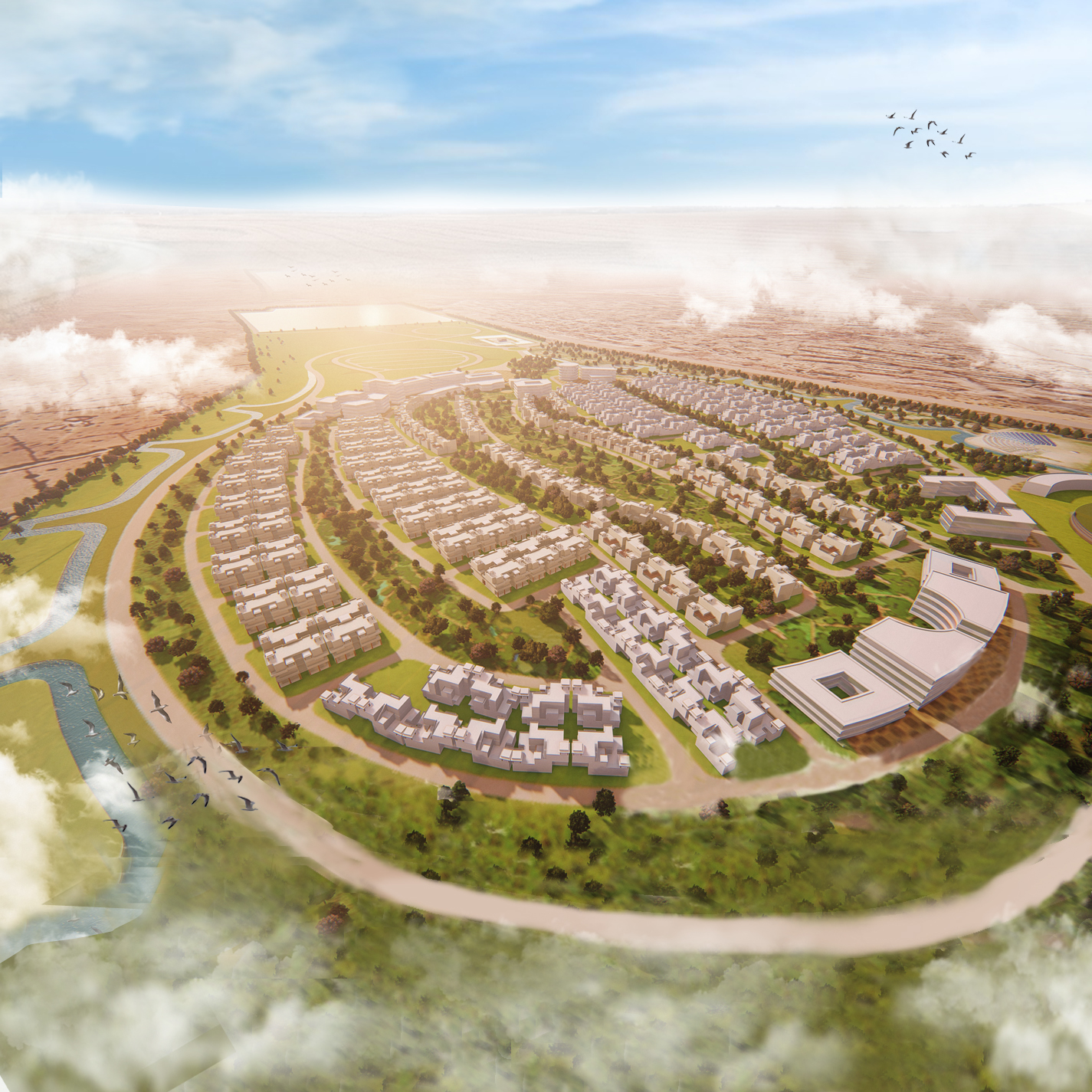
While the dedication of the HPCL Rajasthan Refinery Limited (HRRL) Integrated Refinery-cum-Petrochemical Complex by Prime Minister Narendra Modi marks a significant milestone in India’s industrial growth, the accompanying HRRL Township in Barmer is emerging as an important benchmark in climate-responsive architecture and sustainable urban planning.
Designed by CP Kukreja Architects, the 248-acre township transforms one of India’s harshest desert landscapes into a resilient, self-sustaining community. Rather than treating employee housing as supporting infrastructure, the master plan reimagines industrial townships through ecological planning, passive design, and locally rooted architectural principles.
Inspired by Rajasthan’s traditional johad water-harvesting system, the township is organised around a hydrological network that integrates rainwater management with public spaces, housing clusters, and community amenities. This landscape-led planning approach allows water conservation, ecology, and everyday life to shape the urban fabric.
Responding to extreme desert temperatures, saline soils, and water scarcity, the architecture incorporates passive cooling strategies including thermal mass construction, shaded openings, internal courtyards, cross ventilation, high-reflectance roofs, and vernacular elements such as jaalis and jharokhas to improve environmental performance. More than 30 percent of the site has been dedicated to open landscapes, shaded pedestrian corridors, and community spaces, reinforcing both environmental resilience and social wellbeing.
The township has received the HUDCO Design Award and a 4-Star GRIHA Rating for Large Developments, recognising its commitment to sustainable planning, resource efficiency, and context-sensitive design. Environmental measures such as 100 percent rooftop rainwater harvesting, treated wastewater reuse, solar-powered street lighting, native landscaping, and the plantation of over 5,000 indigenous trees significantly reduce water and energydemand.
Commenting on the project, Dikshu C. Kukreja, Managing Principal, CP Kukreja Architects, said, “The HRRL Township demonstrates that industrial development can be planned as a resilient civic ecosystem. By drawing from indigenous water systems, passive design strategies, and community-centred planning, the project presents a contemporary model for sustainable settlements in India’s arid regions.”
As Barmer evolves into a major industrial hub, the HRRL Township offers a compelling example of how architecture can move beyond functional infrastructure to create environmentally responsive, socially inclusive, and future-ready communities.