



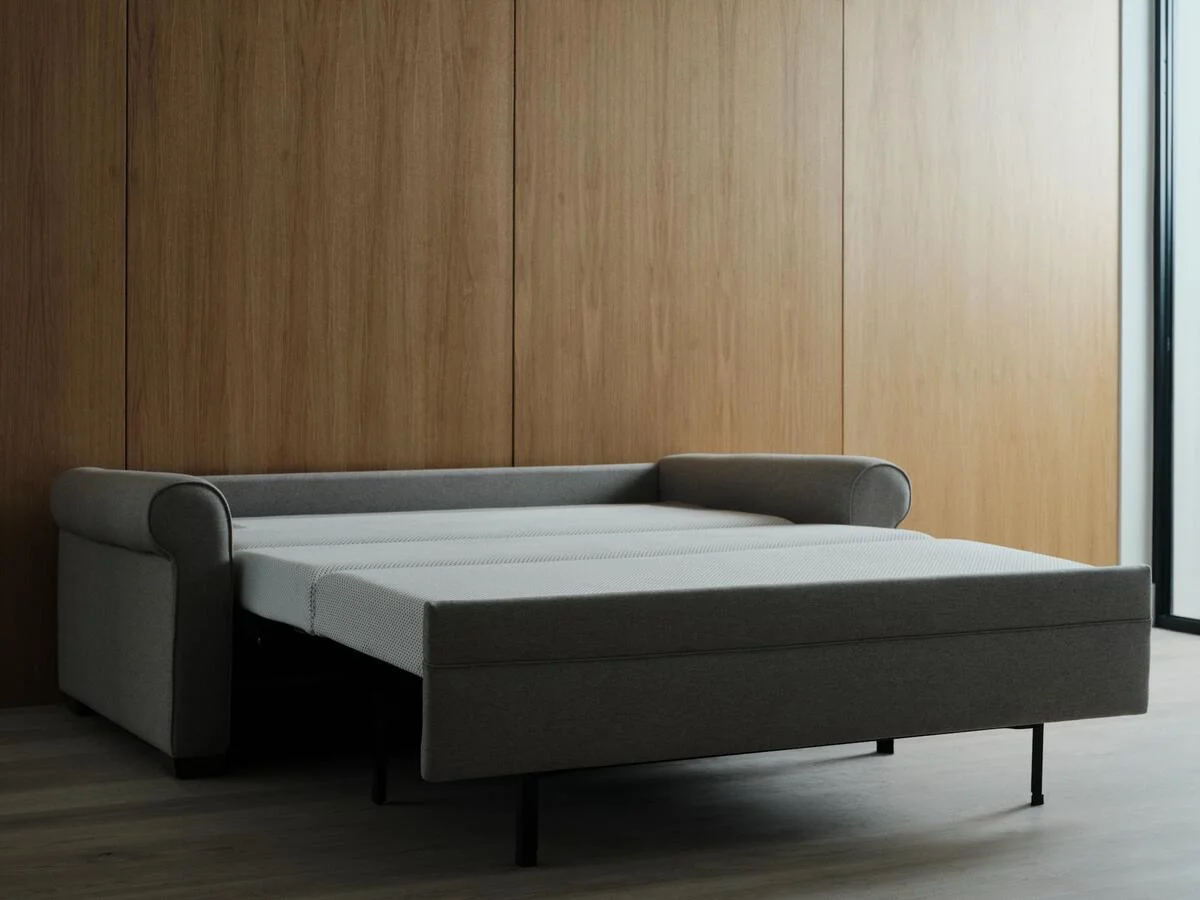
Updated Dual-Purpose Seating Balances Sleep Comfort, Compact Footprints, and FF&E Aesthetics
Market Shift
Flip though enough design catalogs, and you’ll be confronted with a curious development: the stylish sleeper sofa. Dig a little deeper, and you’ll find that these multitasking furniture pieces have also evolved to be surprisingly comfortable. For interior designers specifying for apartments, hospitality, and ADUs, the new generation of sleeper sofas addresses both footprint constraints and client expectations for refined upholstery. Gone are the days of clunky box springs, uncomfortable bars, eyesore designs, and confusing mechanisms that take two or more people to unfold. With sleek designs that don’t sacrifice comfort, a new wave of dual-purpose pieces are proving they’re worthy of more than just the basement.
Space Efficiency Drivers
“As real estate prices and rent go up, people are left in smaller spaces than they might have been five or 10 years ago. In smaller spaces, inherently, people need more multifunction,” says Lance Trachier, the creative director at American Leather, an industry leader in cushioned seating. “Typically, when I think of sleeper sofas, it’s usually in the guest room, but we’re seeing a lot more people using sleeper sofas as their primary sleeping surface. In a small studio apartment in a metropolitan area where someone doesn’t have enough space to have a living room and a bedroom, they can use these as a really great two-for-one.” For architects planning micro-units and hospitality suites, sleeper sofas reduce program area while maintaining living room function, impacting circulation, egress, and furniture plans.
Sofa-First Specification
Phantila Phataraprasit, the CEO of sustainable furniture company Sabai, has also seen sleepers being used as a primary sofa. “Especially for customers in apartments or smaller homes where the living room has to do triple duty as a TV room, home office and guest room—that changes everything about what people are looking for,” she says. “They’re not willing to settle for a sleeper that looks like a sleeper anymore. It has to be the sofa they actually want, that happens to also turn into a bed.” For FF&E packages, this shift means designers can specify sleepers without compromising upholstery grade, arm profile, or leg detail. The Eclipse collection features 70- and 90-inch sofa versions that fold out into a queen-size mattress, as well as a sleeper chair—all of which are available in three different fabrics and dozens of colors.
Rental and Hospitality Demand
The rise of rental properties on platforms like Airbnb and Vrbo has also caused an uptick in demand. “The need for additional multipurpose sleepers has increased,” says Dixon Mitchell, CEO of North Carolina furniture company Fairfield Chair. “Property owners are looking for space efficiency and flexibility within their sleeping arrangements, and the sleeper sofa is a great solution for providing additional guest accommodations without sacrificing the overall design of the space.” For hotel and short-term rental interiors, sleeper sofas increase occupancy counts without adding bedrooms, aligning with code-required sleeping surfaces while preserving lounge layouts and sightlines to views or TVs.
Mechanism Innovation
Until recently, the market provided consumers with few options and little choice. But new technologies have allowed for advancements that make some sleepers just as comfortable as a regular mattress. “We entered this market because the existing models were just terrible,” says Trachier. “They were always terrible sofas and terrible sleepers—it was kind of the worst of both worlds. And so it really started as an exercise in trying to figure out how to make the best of both worlds.” To achieve these goals, the bed mechanism technology had to change. Brands worked with engineers to create conditions that resemble a traditional platform bed; unlike first-generation sleepers, the mattress doesn’t fold into parts and get stuffed under the cushion—instead, the effect is more like that of a box spring, or the slatted bars that distribute support across the length of the mattress.
Platform and Trundle Systems
“What you probably conjure in your mind of a sleeper sofa, it’s usually a spring mattress folded in half,” says Trachier. “Because it’s a loose-spring core, they have to put bars to support that mattress so you don’t sink, and over time, you just feel those bars. Everybody has a memory of sleeping on grandma’s pullout couch and remembers the springs and the bars as being really uncomfortable. We figured out a three-platform mechanism that, for lack of a better word, ‘origamis’ into a sofa. Instead of everything having to sit underneath the seat, some of it sits underneath the back of the sofa. It is a very smart use of space, which allows us to both have a bigger mattress when it’s unfolded and have a better seating experience when it’s full.” Los Angeles–based interior and furniture designer Kim Salmela’s Jasper sofa for Norwalk also doesn’t fold on itself, allowing for more leeway in the rest of the sofa design. “What I love about the Jasper is that you have a really clean look because the trundle itself is really the front rail, so it slides out, and then just pops up to meet the same height as the top of the seat and turns into a bed.”
Design Integration
The upsides to many of these new sleeper sofa designs aren’t just aesthetic—they’ve also eliminated the need for confusing mechanics or uncomfortable bars that dig into your back. “The mechanism needs to be intuitive and easy to convert from sofa to bed and back again, without requiring two people or a wrestling match,” says Phataraprasit. Given the prominence of these pieces in a room, visual appearance has become an increasingly important factor. American Leather’s wide array of sleeper styles range from transitional to contemporary and are available in hundreds of different fabric and leather options for a fully customizable look. Fairfield’s Katy twin sleeper boasts scallop trim and comes in a range of styles and fabrics as well—a seat so cute you’d never guess it pulled out into a bed. “Having a customer react with surprise that the upholstered sofa is actually a sleeper is a huge win,” says Mitchell.
Specification Strategy
Salmela had the sofa design top of mind when creating the Jasper. “I just, ‘Why can’t sleeper sofas look like real sofas? Why do they have to be straight, track-arm, two cushions, loose seat?’” she says. “I wanted something that was stylish, but really could lend itself to different design aesthetics.” The crux of the matter is, it’s about striking the right balance between sleep comfort and seat comfort and not sacrificing on either end. “If you start with the sofa silhouette and try to retrofit a bed mechanism into it, you end up compromising the sleep experience,” says Phataraprasit. “If you start with the bed and build a sofa around it, you get something that looks like a piece of convertible furniture rather than a beautiful sofa. Our approach was to design for both from day one, treating it as a single object that has to perform two jobs equally well.” For specifiers, this means verifying mattress depth, support grid, and fabric durability alongside seat density and frame construction.
Image Courtesy: Business of Home