



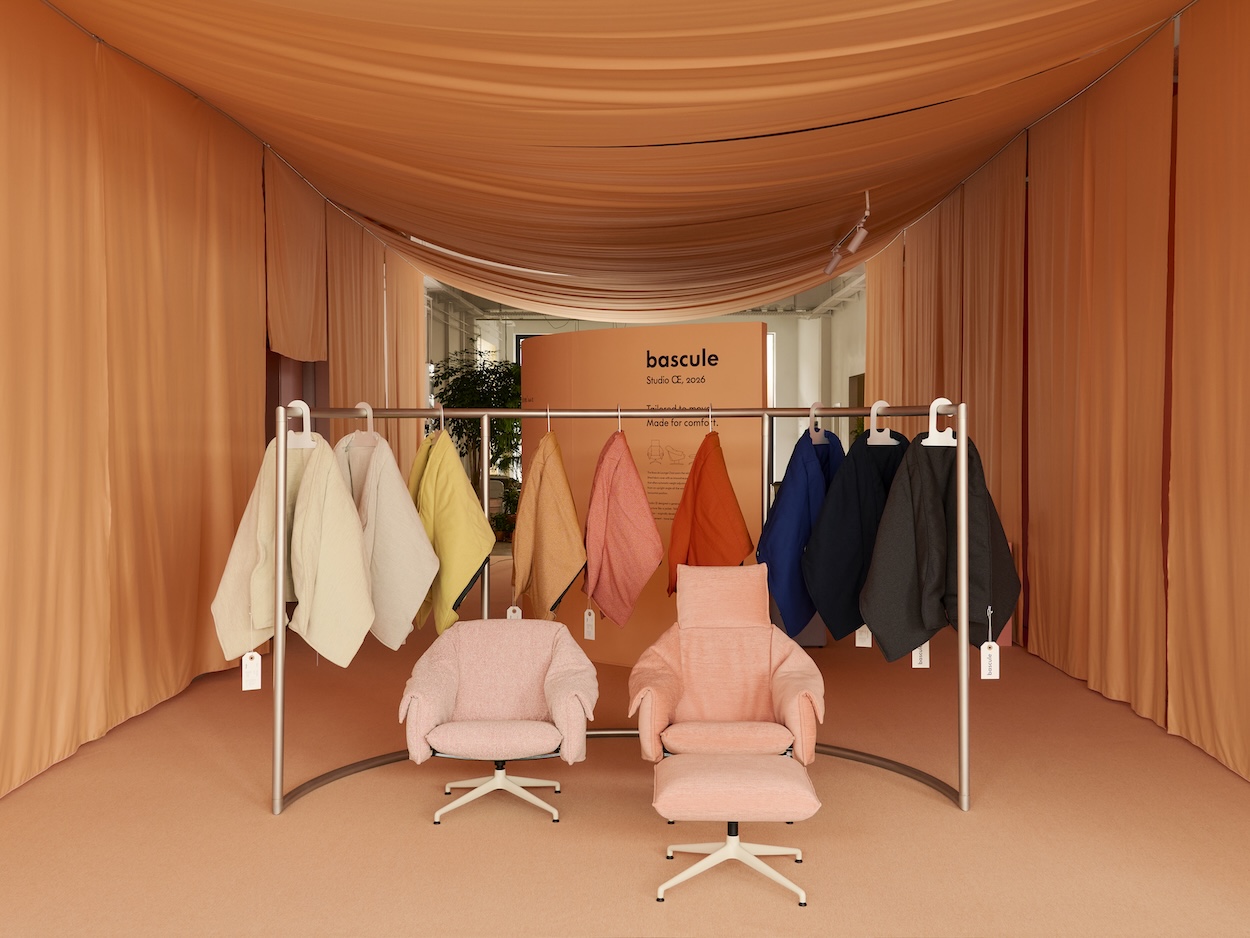
Developed in Switzerland by Vitra, in collaboration with Lisa Ertel and Anne-Sophie Oberkrome of Berlin-based Studio Œ, the Bascule lounge chair conveys a relaxed visual language through its loosely fitted fabric adornment. Introduced at 3daysofdesign, the chair, which comes with a four-star aluminium swivel base or a wooden base, in a highback version or as a lowback model, only employs separable materials and uses no adhesive. Furthering its sustainable composition, the cover is removable, repairable, and replaceable. The launch reflects a growing focus on circular design in contract and residential seating, where disassembly and material recovery are specified alongside comfort and aesthetics.
The debut of an underlying technology accompanies the Bascule release, an engineering advancement that allows the chair to adjust to a user’s weight. It enables a smooth transition from the sitting to reclining positions. The name, which is French for seesaw, acknowledges this movement. “At Vitra, there is a close, ongoing dialogue between our engineering team and the designers as we develop products,” Christian Grosen, the Chief Design Officer of Vitra, tells Surface. “With Studio Œ, the mechanism for Bascule was adapted throughout the design process to meet the demands and opportunities presented by the concept,” Grosen continues. The mechanism removes the need for manual levers or locking controls, letting the sitter’s body dictate the recline angle.
Studio Œ looked to the fashion world for tailoring techniques that allowed the fabric to dress the lounge chair while also supporting its movement. Ertel and Oberkrome observed the fabric’s response to the chair’s movement, as it stretched and loosened, and adjusted accordingly. “For us, the comparison with a jacket couldn’t be more fitting, a favorite jacket you love to slip on, one that is soft, familiar and simply comfortable,” the studio shared in a statement. In line with this, and contributing to the lounge chair’s versatility, the fabric cover can be changed for another colorway if circumstances or tastes change over time. The tailoring approach treats the cover as a garment rather than upholstery, with darts, seams, and ease calculated to move with the frame.
Material selection reinforces the chair’s serviceability. By avoiding adhesives and using only separable components, Vitra ensures that metal, wood, and textile streams can be disassembled at end of life. The removable cover supports repair and refresh cycles, extending product lifespan without replacing the entire chair. The four-star aluminium swivel base addresses workplace and hospitality settings, while the wooden base suits residential interiors. Both highback and lowback versions share the same recline geometry, giving specifiers options for privacy or openness within a single family. This modularity aligns with sustainable lounge seating strategies that reduce stock keeping units while increasing application range.
The engineering dialogue between Vitra’s team and Studio Œ shaped how the mechanism integrates with the fabric behavior. Traditional lounge chairs often rely on tensioned membranes or fixed shells, which limit how the cover can move. Bascule decouples the comfort layer from the structural recline, allowing the fabric to drape and recover without stress points. That decision improves tactile comfort and prevents the puckering or binding that can occur when upholstery fights the motion of a mechanism. The result is a chair that reads as soft and domestic, yet meets the performance requirements of high-use environments. Photography by Benjamin Lund from 3daysofdesign captures the chair’s relaxed silhouette and the way the fabric forms around the user.
Introduced during Copenhagen’s 3daysofdesign, Bascule enters a market where specifiers are balancing wellbeing, longevity, and environmental impact. The ability to replace covers without tools supports facility managers seeking to update interiors or address wear without full reupholstery. For residential buyers, the jacket-like cover invites personalization over time, treating the chair as an evolving object rather than a fixed finish. Vitra’s history of collaborating with external designers, from Charles and Ray Eames to Jasper Morrison, continues with Studio Œ, whose background in fashion and product brings new detailing to furniture engineering. More on Vitra’s design approach and product lifecycle policies is available via the Vitra official website.
Bascule’s seesaw motion, separable construction, and changeable cover position it as a response to both user comfort and circularity mandates. As clients demand documentation on disassembly and material health, the absence of glue and the provision for part replacement become specification advantages. The chair does not lock into a single aesthetic or function, adapting to body weight, base choice, and fabric selection. That adaptability, paired with Vitra’s manufacturing standards, makes Bascule relevant for lobbies, lounges, home offices, and hospitality suites where long-term value and visual softness are equally important.
Image Courtesy: Benjamin Lund, SURFACE