


Jura Workshop Merges Sculptural Wood with Bespoke Home Solutions
Workshop Vision
In the heart of the Jura region, a workshop is redefining the boundaries between furniture and sculpture: Thouret Furniture. For architects and interior designers specifying high-end residences, hotels, and chalets, the atelier represents a shift toward collectible design where material integrity and spatial integration drive value. Traditional cabinetmaking by artisan-artists does not simply work with wood, but shapes it to reveal its soul. For nearly thirty years, this family house has embodied a unique vision of French handcrafted furniture where technical mastery meets contemporary design. In interiors, these pieces act as anchors for lighting plans, concealed services, and spatial zoning, demanding coordination with MEP and joinery teams to protect finishes and ensure structural support for sculptural forms.
Material Language
History Thouret Furniture is inseparable from its territory. Located in Belmont, the workshop draws its inspiration from the Jura forests that surround it. Oak, ash, elm, or walnut are selected for their unique character, grain, and aesthetic potential. For interior specifications, this deeply rooted approach gives projects a rare identity: French craft rooted in locale yet aligned with international codes of collectible furniture. Each plank is chosen as a living raw material destined to become an exceptional piece. Designers working on bespoke homes integrate these elements with stone, metal, and glass, requiring precise detailing of floor loads, humidity control, and lighting to enhance the wood’s depth without compromising climate stability inside premium envelopes.
Craft Transmission
At the heart of this Jura house lies, first and foremost, a story of transmission. The story of Olivier Thouret, a master craftsman whose career began in the early 1990s in the purest tradition of French cabinetmaking, with its emphasis on precise technique, controlled lines, and absolute respect for the material. After decades perfecting classic skills, he shifted toward a more contemporary style, developing the now-emblematic technique of torn wood. Alongside him, his son Louis Thouret extends this vision with experimentation and innovation. For fit-out teams, this father-son dialogue ensures continuity of tolerances, joinery details, and finish protocols that align with high-end interior execution where millwork, stone, and integrated services must coexist seamlessly.
Signature Technique
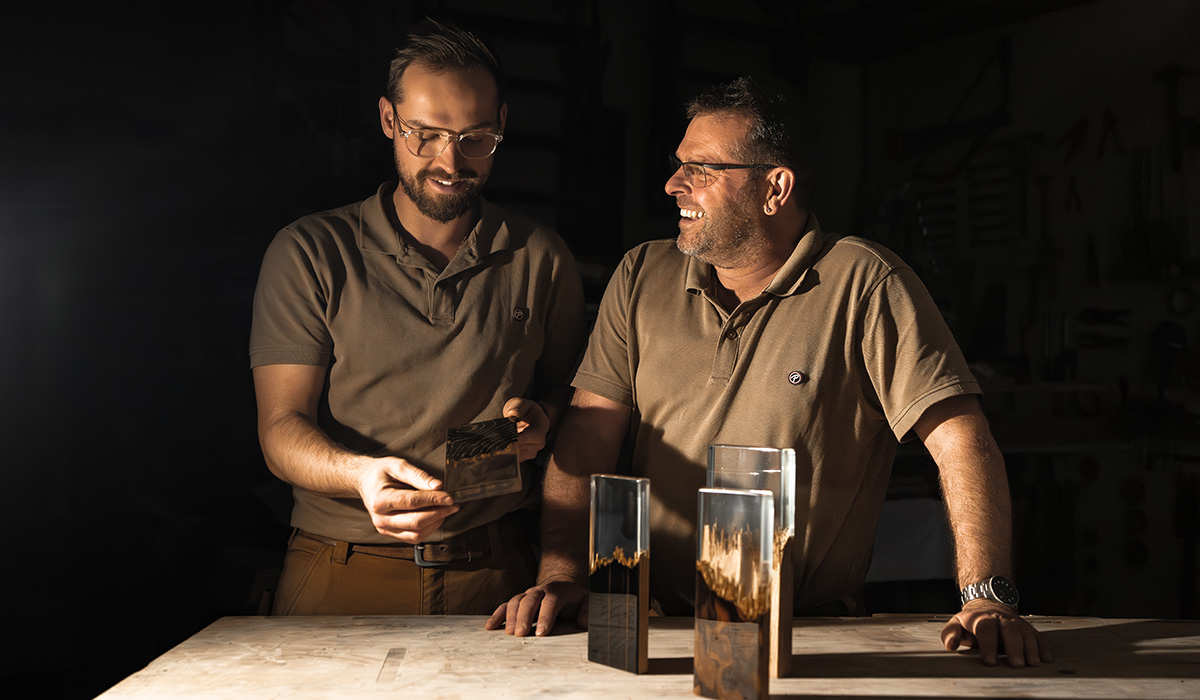
At the heart of the house’s identity lies a technique that has become its signature: the torn wood. After years of research, artisans developed a method that involves inducing the natural fracture of the wood to reveal its deep fibers. This raw material is then stabilized in a bio-based resin of absolute transparency, creating a spectacular encounter between nature and technology. Since each fracture is unique, no creation can be reproduced exactly. For interior architects, this positions each piece as a unique collectible design, halfway between a work of art and a functional object. Integration requires coordination with lighting designers to activate transparency, and with structural teams to manage weight distribution of resin-stabilized forms in floating staircases, lobbies, and master suites.
Workshop Process
Visiting the Meubles Thouret workshop is almost a ritual. The experience begins with a tactile exploration of the collections in the showroom. It continues in the design studio where sketches take shape before being brought to life in the workshop, where the cabinetmaker’s hand transforms raw materials into exceptional objects. For project stakeholders, this immersive journey clarifies lead times, customization thresholds, and site requirements for installation. Understanding the time, precision, and sensitivity required informs interior programs, sequencing of trades, and protection plans for finished pieces during construction. The process aligns with luxury residential and hospitality briefs where furniture is commissioned alongside architecture, not after.
Iconic Works
Among the iconic creations, Casting stands out as a manifesto piece: this sculptural bathtub with fluid lines gives the impression that the material has been captured in its original movement, as if suspended between organic power and transparency. Onyx, an exceptional table, reveals the depth of the wood grain in a subtle dialogue with the resin, offering an almost mineral reading of the surface. Rivage develops a more contemplative style, where natural lines evoke slow erosion and the passage of time. With Magma, the workshop explores an even more radical expression: the piece seems to emerge from an inner impulse. These works require MEP coordination for wet areas, reinforcement for heavy tops, and lighting strategies that reveal resin depth while meeting hospitality-grade durability.
Design Impact
Through these works, the house asserts an immediately identifiable signature: that of a French art furniture where the artisanal gesture does not seek to domesticate the material, but to reveal its original strength. These creations naturally find their place in architecturally designed private residences, exclusive hotels, contemporary chalets, or high-end interior design projects where the furniture becomes an aesthetic marker. In a world dominated by industrial production, the Jura workshop is a reminder of the power of craftsmanship. For the interiors and home solutions sector, Thouret signals a return to authentic, sustainable luxury where the value of an object is measured by the time it took to create it, and where millwork, material, and space are conceived as one.
Image Courtesy: Luxe Infinity/Thouret Furniture