



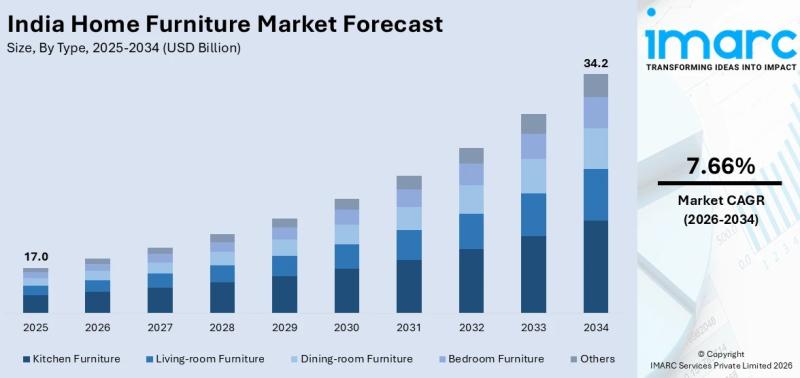
According to IMARC Group’s report titled “India Home Furniture Market Size, Share, Trends and Forecast by Type, Distribution Channel, and Region, 2026-2034”, the India home furniture market size reached USD 17.0 Billion in 2025. Looking forward, IMARC Group expects the market to reach USD 34.2 Billion by 2034, exhibiting a growth rate (CAGR) of 7.66% during 2026-2034. The report offers a comprehensive analysis of the industry, including India home furniture market forecast, growth and regional insights. The Indian retail landscape is experiencing a massive structural shift as the home furniture market digitizes and premiumizes, fueled by a booming e-commerce sector and rapid urbanization. For retail executives and corporate investors, this presents a high-yield opportunity to capitalize on an industry rapidly transitioning from highly fragmented, unorganized carpentry to a branded, technology-driven omnichannel ecosystem.
Market Valuation
Valued at USD 17.0 Billion in 2025, the market is poised to double, reaching an estimated USD 34.2 Billion by 2034, registering a steady CAGR of 7.66%. E-Commerce Catalyst: With India’s e-commerce industry projected by IBEF to hit USD 325 billion by 2030, online furniture retail and Direct-to-Consumer (D2C) brands are aggressively capturing unprecedented market share. For real estate developers and interior designers, the forecast signals sustained demand for premium, branded interiors across residential projects. The shift from unorganized carpentry to tech-driven omnichannel models shortens procurement timelines and raises finish-quality benchmarks, influencing specification standards in new housing and renovation segments across metros and Tier-2 cities.
Consumer Drivers
The exponential rise of nuclear families living in compact urban real estate is skyrocketing the demand for modular, space-saving, and multifunctional furniture designs. Tech-Enabled Purchasing: Augmented Reality (AR) and Virtual Reality (VR) integrations are fundamentally transforming the consumer journey, driving high-value, customized orders by bypassing physical showroom dependencies. Architects and interior designers must now integrate hidden storage, convertible formats, and tech-enabled utility to address shrinking square footage in Tier-1 cities. AR virtual staging lets homeowners visualize high-ticket pieces in actual layouts, reducing return rates and enabling earlier specification during design development phases of residential and rental projects.
Retail Disruption
A critical operational blindspot for legacy retail executives is treating digital sales channels as secondary, severely underestimating the aggressive consumer pivot toward tech-enabled Direct-to-Consumer (D2C) brands. Many traditional retailers are ignoring the immediate need to integrate Augmented Reality (AR) visualization tools, continuing to rely on high-overhead, localized physical showrooms that fail to scale nationally. Ignoring this digital disruption creates a severe ripple effect across the broader Retail sector in India. It leads to crippling inventory holding costs for massive physical showrooms, plummeting foot traffic, and severe margin compression. Omnichannel showrooming is replacing inventory hubs with curated experience centers for customized digital orders.
Policy Support
Sovereign infrastructure mandates and massive smart city projects are standardizing modern housing designs, directly driving the structured procurement of contemporary, space-optimized furniture for urban populations. Housing for All Initiatives: Aggressive government housing schemes across semi-urban and urban zones are permanently expanding the baseline consumer pool, generating sustained, high-volume demand for essential and affordable home furnishings. D2C and Manufacturing Subsidies: Strategic policy support for domestic manufacturing and digital retail integration is incentivizing brands to heavily localize their supply chains, systematically reducing import dependencies on raw materials and finished goods for the construction and real estate ecosystem.
Investment Outlook
India’s hyper-urbanization and rising middle-class disposable incomes are triggering an unprecedented demand for home renovations. Investors backing scalable retail networks will secure long-term profitability by catering to an expanding demographic hungry for premium, aspirational living spaces. Tech-Upgraded Premiumization: The market is rapidly shifting from commoditized carpentry to high-margin, brand-driven smart furniture. Capitalizing on IoT-enabled designs and eco-friendly materials offers substantial profit margins, allowing retailers to capture high-intent buyers willing to pay a premium for ESG compliance. Supply Chain Efficiencies via E-Commerce: Formalized logistics and marketplace partnerships reduce warehousing bottlenecks, enabling pan-India delivery with lower capex for D2C brands.
Market Segmentation
The report covers Type Insights including Kitchen Furniture, Living-room Furniture, Dining-room Furniture, Bedroom Furniture, and Others. Distribution Channel Insights span Home Centers, Specialty Stores, Flagship Stores, Online, and Others. Regional Insights include North India, South India, and East India with historical data from 2020-2025. Future Outlook: Rise of Smart and Multifunctional Designs, Omnichannel Showrooming, Sustainable Material Sourcing from reclaimed wood and bamboo, and AR Virtual Staging are defining the next phase. These trends align with construction cycles, allowing architects and developers to synchronize interior specifications with evolving consumer expectations and regulatory standards.
Image Courtesy: Open PR

