



India Nepal School Project sets a new benchmark for cross-border educational infrastructure as the Government of India extends financial assistance for a purpose-built school building in Nepal. The development aligns with regional trends in resilient institutional architecture and reinforces India’s commitment to augmenting social infrastructure across South Asia. For architects and urban planners, the project highlights how bilateral aid is shaping public building typologies in remote, high-altitude contexts.
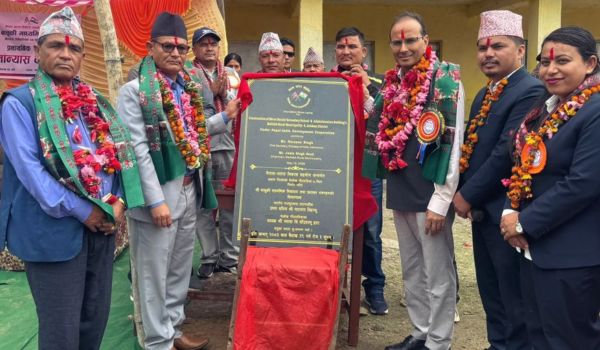
The foundation stone for the construction of Basuki Secondary School, Mellekh Rural Municipality in Achham district in Sudurpaschim province of Nepal, was jointly laid today by Narayan Singh, First Secretary, Embassy of India, Kathmandu; and Jwala Singh Saud, Chairman, Mellekh Rural Municipality. The school building is being built with Government of India’s financial assistance of Nepali Rupees 38 million approximately. This High Impact Community Development Project will be implemented through the Mellekh Rural Municipality, Achham. The architectural brief prioritizes seismic resilience, climate-responsive design, and low-maintenance materials suited to the monsoon and hill terrain of Sudurpaschim.
The programmatic layout integrates earthquake-resistant reinforced cement concrete framing, passive ventilation strategies, and north-south classroom orientation to optimize daylight while reducing heat gain. Planners have specified separate sanitation blocks for boys and girls, administrative offices, science laboratories, and a library to meet evolving pedagogical needs. Site planning addresses surface drainage and slope stabilization, critical for construction in Achham’s topography. Local stone and timber will be used for cladding and interior finishes to reduce embodied carbon and support regional craft, tying the India Nepal School Project to vernacular material palettes while meeting modern codes.
The Chairman of Mellekh Rural Municipality, Achham and other stakeholders appreciated the developmental support being provided by the Government of India and expressed confidence that the new infrastructure would help enhance the learning environment for students and educators in Mellekh Rural Municipality, Achham. From an urban planning perspective, the facility is expected to function as a community node, reducing student travel distances and enabling the site to serve as an emergency shelter. Real estate stakeholders in Sudurpaschim note that upgraded civic infrastructure often catalyzes surrounding land-use improvements and informal settlement upgrades.
As close neighbours, India and Nepal are engaged in wide-ranging and multi-sectoral cooperation. The implementation of High Impact Community Development Projects reflects the continued support of the Government of India in strengthening the efforts of the Government of Nepal in promoting growth and development, apart from augmenting infrastructure in priority sectors. For the architecture and construction industry, the India Nepal School Project demonstrates a grant-based delivery model where local rural municipalities act as implementing agencies, ensuring contextual design decisions and faster approvals. The Embassy of India, Kathmandu provides technical oversight on structural safety and compliance.
The High Impact Community Development Project model disburses funds in tranches linked to construction milestones, from foundation to finishing. Mellekh Rural Municipality will oversee contractor procurement, material testing, and site supervision. Specifications call for modular classroom units to allow future horizontal expansion without disrupting operations. Civil engineers have incorporated rainwater harvesting and solar-ready roofing into the plan, aligning the India Nepal School Project with emerging standards for green institutional buildings in Nepal. The emphasis on lifecycle costing will aid long-term facility management by the school committee.
Regional Significance
Achham district presents logistical challenges for construction, including limited access roads and skilled labor shortages. The project’s execution strategy therefore includes on-site skill training and use of prefabricated components where feasible. Urban planners view the school as a catalyst for structured growth in Mellekh, potentially anchoring future zoning for educational and healthcare clusters. With over 550 similar projects completed across Nepal since 2003, India’s development partnership has become a reference for how targeted infrastructure grants can fill critical gaps in rural masterplans while respecting local architectural identity.
Upon completion, Basuki Secondary School will offer a safe, inclusive, and technologically adaptable environment for students and teachers. The India Nepal School Project not only upgrades built assets but also sets design precedents for institutional buildings in comparable geographies. For readers of Architecture Update, the project underscores three key takeaways: the growing role of bilateral funding in public architecture, the integration of resilience and sustainability in rural school design, and the importance of municipal-led implementation for context-driven construction outcomes across the Himalayan belt.

