



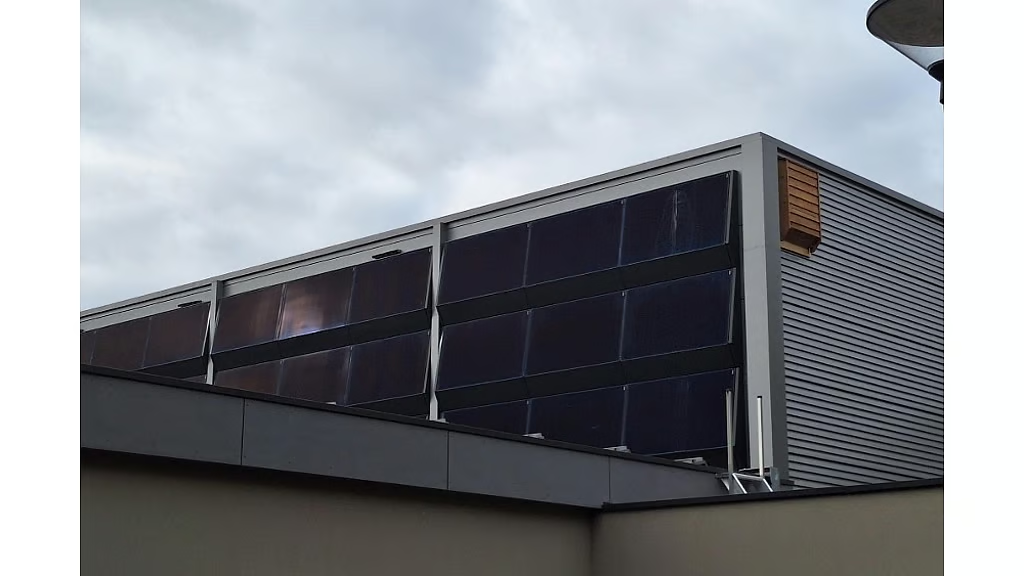
The Netherlands Enterprise Agency, RVO, reports that façades of offices, commercial buildings, schools, and other non-residential buildings in the Netherlands can host around 36 GW of solar energy. Commissioned by the Dutch Ministry of Economic Affairs and Climate Policy, the research explores using solar panels on façades of existing non-residential buildings. Currently, less than 0.1% of all solar panels in the Netherlands are mounted on façades.
Most of the 19 solar projects on existing non-residential buildings in the country have capacities under 50 kW, while the largest has an installed capacity of 250 kW. RVO also studied 14 international projects, including a 1 MW warehouse installation in Germany. The research identifies 2 promising use cases. One is buildings with full or unsuitable roofs but high energy demand such as warehouses, distribution centers, and office buildings with large façades. The other is buildings where appearance matters, like premium offices or public buildings where colored or printed solar panels may be preferred despite higher costs.
Building-integrated photovoltaics on façades shift PV from MEP scope to building envelope design. Solar cassettes set at optimal angles can improve yield while functioning as rainscreen cladding. For premium offices and civic buildings, printed or colored modules allow architects to maintain material palettes and façade rhythm without visual compromise. Façade PV influences window-to-wall ratios, structural loads, fire detailing, and access for maintenance. Early coordination between façade consultants, architects, and PV engineers is critical to meet both aesthetic rules and performance metrics.
Despite potential, façade PV faces challenges such as permit requirements, higher costs, rules related to building aesthetics, and limited awareness of subsidies. RVO recommends easing permit rules or increasing knowledge sharing to help adoption. The research authors agree that rooftop PV is generally more effective than façade PV for most existing non-residential buildings, especially when designed for self-consumption due to grid congestion. However, they recommend that façade PV can work in specific cases if supported by better guidance, data on costs and returns, and clearer regulations.
Policy and Market Direction
Authorities can help by promoting knowledge sharing and exploring applications on public buildings, while industry players should look at standardizing terminology and developing tailored solutions with clear financial insights for different building types, recommends the report. Switzerland offers additional subsidy for solar panels installed at an angle greater than 75 degrees, showing how policy can enable vertical applications. The complete research, in Dutch, is available for free download on RVO’s website. For broader context see Building Integrated Photovoltaics Europe. For agency updates visit RVO.
Image Courtesy: Taiyang News

