



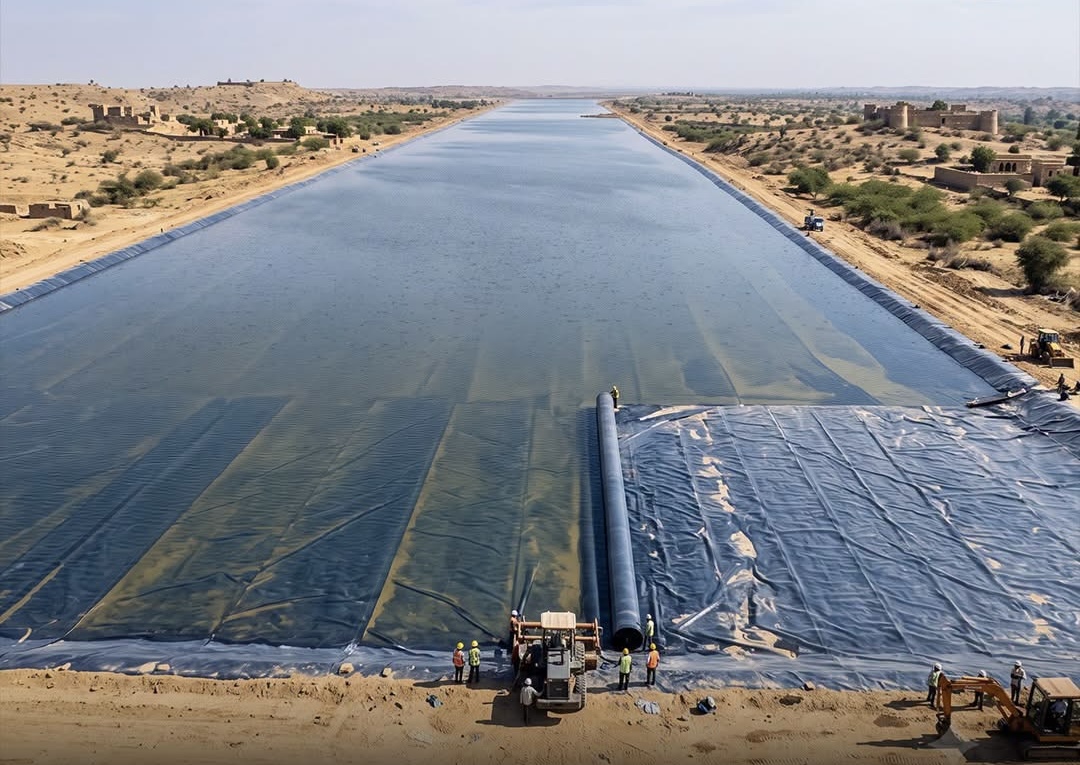
Rajasthan has completed a 28-km artificial reservoir in the Thar Desert, demonstrating how large-scale engineering and infrastructure design can address water security challengeschallenges in arid regions. The project is expected to supply drinking water to nearly 5 million people in Jaisalmer and Barmer during annual disruptions to the Indira Gandhi Canal.
Developed by the Rajasthan Public Health Engineering Department at an estimated cost of ₹242 crore, the reservoir has a storage capacity of around 1.41 billion litres and a depth of 33 feet. The facility has been created as a strategic water reserve to ensure uninterrupted supply when the Indira Gandhi Canal undergoes its scheduled annual maintenance.
From an infrastructure and engineering perspective, the project’s defining feature is its 300-micron high-density polyethylene (HDPE) liner, installed across the reservoir bed to prevent seepage into the porous desert sand. The geomembrane creates an impermeable barrier, significantly reducing water loss through infiltration while improving the long-term efficiency of the storage system.
To protect the liner from extreme temperatures, UV exposure and mechanical damage, engineers have covered it with a layer of soil, creating a durable foundation capable of withstanding harsh desert conditions. The intervention reflects the growing use of geosynthetic materials in India’s water infrastructure projects to enhance durability, resource efficiency and lifecycle performance.
The reservoir has been integrated with the region’s water treatment and distribution network, allowing canal water to be stored, treated and supplied during periods when the canal remains non-operational. The project addresses a long-standing infrastructure gap, as the region previously lacked a large-scale storage facility capable of maintaining water supply during canal shutdowns.
Beyond its utility function, the project highlights evolving approaches to climate-resilient infrastructure, where engineering design, material innovation and strategic planning are being deployed to strengthen water security in environmentally challenging landscapes. The reservoir also supports the objectives of the Jal Jeevan Mission, which aims to expand access to safe drinking water through reliable household connections across India.