


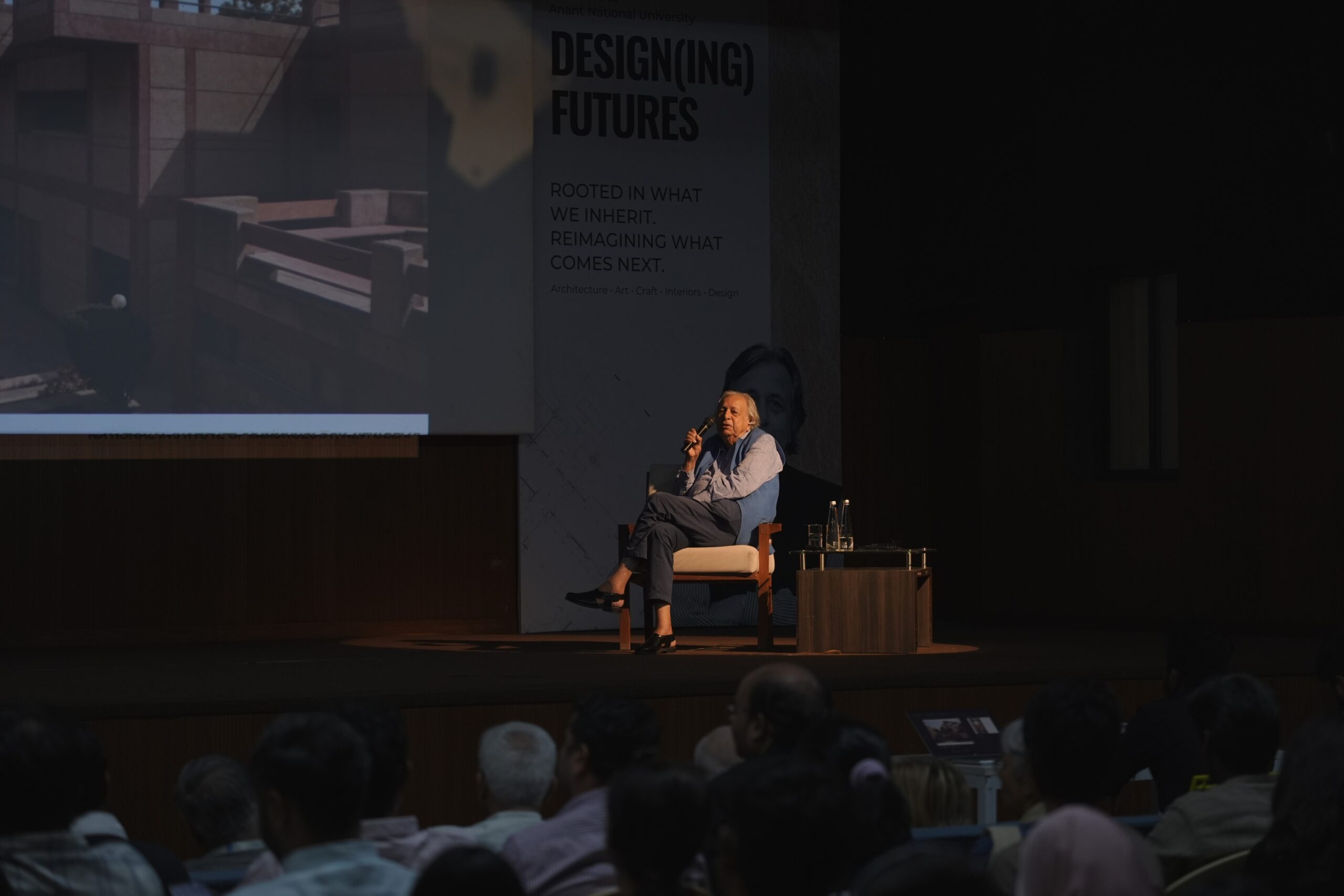
Eminent architect and urban design consultant, Ar Raj Rewal, engaged with the students and faculty of Anant National University at a symposium organised as part of Design(ing) Futures, an initiative developed in collaboration with Global Village Foundation to bring influential voices from architecture, design and allied creative disciplines into conversation with Anant’s academic community.
It offered students an opportunity to interact directly with the architect whose work, spanning more than six decades, has contributed significantly to the evolution of contemporary Indian architecture. Bringing together perspectives from architecture, interiors, art, craft and design, the symposium encouraged students to look beyond disciplinary boundaries and understand design as a practice deeply connected to people, culture and society.
A key highlight of the symposium was the screening of Indian Modernity: The Architecture of Raj Rewal, a film exploring the architect’s work and approach to design. The screening was followed by a talk by Ar Rewal and an open interaction with students, offering them insights into his architectural philosophy that reflects a deep engagement with India’s cultural, climatic and social contexts while responding to contemporary needs. This interaction offered students meaningful insights into how architectural ideas evolve through practice, how designers navigate real-world constraints and how individual convictions shape creative work over time.
During the symposium, Ar Rewal also launched the Backpackers Academy of Life Trail 1: Kerala, an initiative of the Global Village Foundation, with its first trail planned across Kerala in December 2026.
The symposium was envisioned by Dr Sanjeev Vidyarthi, Provost, Anant National University, and curated by Ar Jabeen Zacharias, Professor of Practice, Anant National University. It was coordinated by Prof Risha Roy, Associate Professor and Lead, Sustainable Fashion and Textile Design, and Co-lead, Transdisciplinary Design, Anant National University, with the support of the wider academic and organising team.
The symposium reinforced Anant’s interdisciplinary approach to education by encouraging students to consider how architectural, artistic and cultural traditions can serve as resources for contemporary innovation rather than constraints on new thinking. By facilitating direct engagement with accomplished practitioners and documenting their experiences, Anant aims to create learning opportunities that extend beyond the classroom and contribute to a wider exchange of design knowledge.