



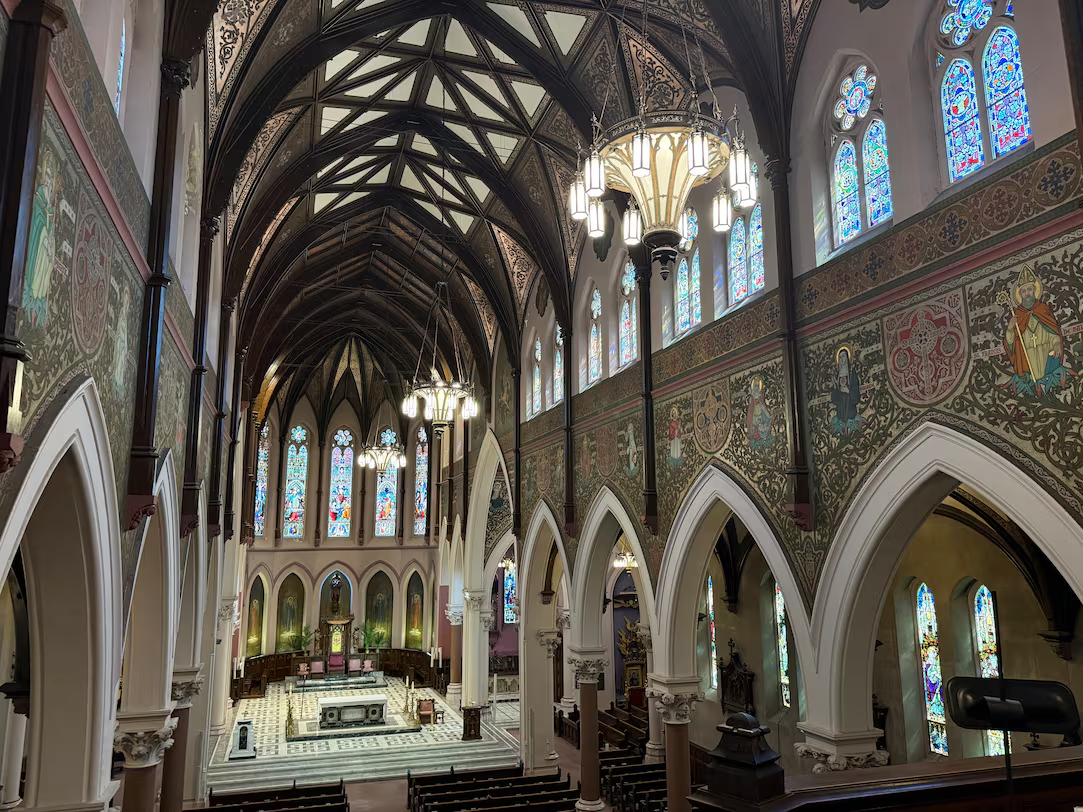
St. Peter’s Cathedral Basilica in downtown London, Ontario, is set to begin a years-long restoration process, repairing and updating the interior from floor to ceiling. The church has stood for more than 140 years and during that time it has undergone extensive restoration work on the exterior, including a roof replacement about 20 years ago. The current three-to-five year project aims to restore the interior of the church “faithfully,” according to Michael Wojtak, the business manager for the London North Central Catholic Family of Parishes. “We still want the warmth and ambiance of a 140-year-old building to be here…We want it to reflect the city’s heritage,” he said. “That’s important to us and I think it’s important to Londoners too.” The initiative underscores the role of heritage conservation in maintaining civic identity and architectural continuity.
Many of the materials used in the interior of the church are long past their expected life, Wojtak said. Extensive water damage is visible on parts of the ceilings and columns, none of the fresco work on the walls and ceilings has been cleaned or touched up since it was initially painted, and there are also fractures in the walls, which will need to be investigated before repairs take place, Wojtak said. The rose pink walls, painted in the mid 1980s, will also be changed to a more neutral cream colour, and he said they are hoping to remove the paint from some of the columns and supports to reveal the natural stone underneath. “It’s a carefully planned process, which is going to take a lot of effort,” he said. Parishioners and visitors can expect to see scaffolding going up in the coming weeks, but the church will remain open for the full duration on the restoration, something that was important to the diocese in the planning process.
Challenges of Restoration and Craftsmanship
“Realistically, had we closed the cathedral, this probably could have been done in a year to a year and a half,” he said. “But our goal is to keep the parish open at all times.” The level of craftsmanship in St. Peter’s is stunning, Wojtak said. When the church was built in the 1880s, almost all the craftsmen had to be brought in from Europe, he added, and many of those skills and trades are not taught in colleges today. The pews were all hand-carved, the Stations of the Cross on the walls were carved by a German craftsman in Kitchener, Ontario, more than a century ago, and the stained glass was imported from Europe. “There are elements in this church which you will not find anywhere else in the city and possibly even the province,” he said. Because of that, this is not the sort of project where the parish can “simply run an ad on Kijiji” asking for wood carvers or plaster restorers. The challenge highlights the need for specialized craftsmanship in restoration and skilled trades preservation.
The parish has brought in London-based a+LiNK Architecture, which will begin putting out tenders for general contractors. “Those general contractors will then start scouting out across the province, and potentially across the country, for people who can restore frescoes, who can restore wood carvings, who can restore the plaster.” The work will be completed in phases, with the first phase focusing on the front section of the cathedral, including the central sanctuary, and east and west chapels and transepts. Wojtak estimated the cost for that initial phase to be around $750,000. The phased approach aligns with best practices in adaptive reuse and restoration for active religious buildings, minimizing disruption while addressing structural and aesthetic deterioration. External guidance on such projects can be referenced through the National Trust for Canada.
St. Peter’s restoration strategy balances authenticity with functionality. While exterior work like the roof replacement occurred two decades ago, the interior now demands attention due to water infiltration, aging finishes, and structural cracking. The decision to shift from 1980s rose pink walls to a neutral cream reflects both conservation ethics and contemporary stewardship of sacred spaces. Uncovering natural stone on columns will reintroduce original materiality obscured by later paint layers. Maintaining public access throughout construction requires complex logistics, scaffolding management, and sequencing that prioritizes liturgical use. The project illustrates how religious architecture conservation navigates technical, historical, and community priorities simultaneously.
Image Courtesy: CBC