



Bhiwandi’s shift: Retail-Led Urban Reconnection
Bhumi World unveiled plans for the Outlet Mall of India, positioning it as a large-format retail development within its broader integrated ecosystem in Bhiwandi recently. Presented at a closed-door preview at Taj Lands End, the project reflects a strategic attempt to introduce a consumption-driven layer into a region historically defined by industrial and logistics activity.
Access to Bhiwandi redefined
Located within a 400-acre integrated development, the project signals a transition in Bhiwandi’s role within the Mumbai Metropolitan Region. Long associated with warehousing and distribution, the area has remained spatially fragmented, with limited public-facing infrastructure. The proposed development seeks to address this disconnect by introducing a destination-oriented format that combines retail, leisure, and community spaces.
Experiential components
The Outlet Mall of India Bhiwandi is planned as a dedicated outlet retail format, bringing together over 150 national and international brands under a year-round discount model. Beyond retail, the project integrates large-scale experiential components, including a 2,500-seater open-air amphitheatre and a one-acre flea market designed for rotating pop-ups and community-driven events, indicating an emphasis on shared public engagement.
Food and beverage infrastructure forms a key part of the planning. A dedicated dining precinct featuring quick service restaurants, fine dining formats, rooftop venues, and a large-format brewery is expected to operate beyond standard retail hours, extending activity across the site. Additional features such as go-karting and golfing facilities reinforce its positioning as a multi-use destination.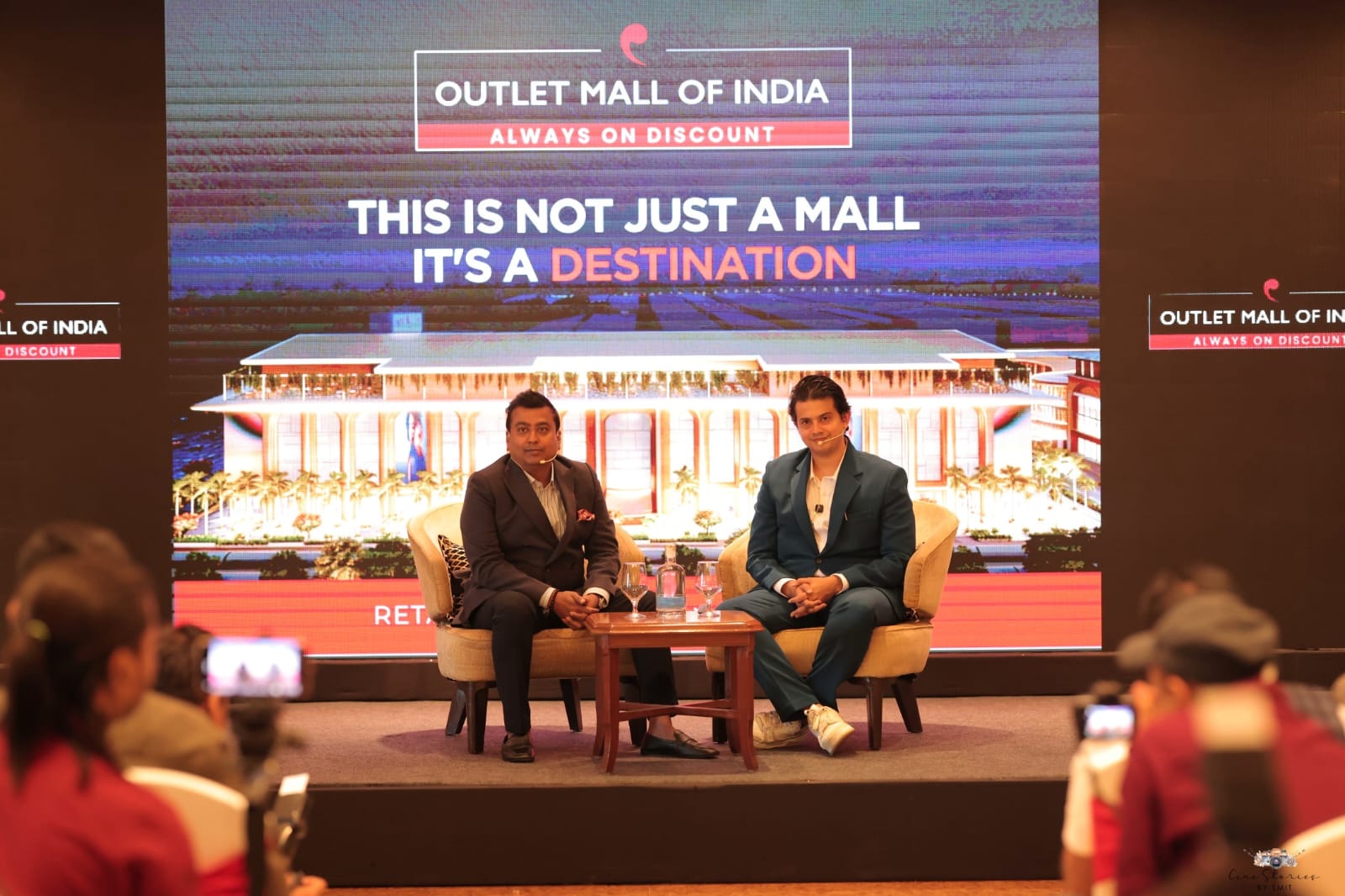
Expansion of Bhumi World
From a real estate perspective, the development represents an expansion of Bhumi World’s existing model, which has primarily focused on industrial parks and plug-and-play infrastructure. The introduction of a retail-led destination suggests a broader shift towards an integrated ecosystem where production, employment, and consumption co-exist within the same geography.
Connectivity remains central to the project’s viability. The site benefits from access to major infrastructure corridors, including the Samruddhi Mahamarg and the upcoming Navi Mumbai International Airport, along with the Pune–Nashik highway. This positions the development within a wider regional catchment spanning Bhiwandi, Thane, Navi Mumbai, and Mumbai. However, its long-term success will depend on whether such infrastructure can support a behavioural shift towards destination-led travel.
Speaking at the preview, Prakash Patel, Managing Director, Bhumi World, said, “Outlet Mall of India represents the evolution of Bhiwandi into a vibrant retail and leisure destination especially for the younger generations by providing access to international products. Our vision is to create a premium, organised outlet platform where consumers experience leading brands, immersive spaces, and unmatched value all year round.”
The project also reflects a broader trend across the Mumbai Metropolitan Region, where peripheral industrial zones are being re-evaluated for mixed-use potential. By introducing public-facing infrastructure and experience-led programming, developments of this scale attempt to address gaps in urban connectivity and social infrastructure.
As outlet retail remains an emerging format in India, the Outlet Mall of India, Bhiwandi will ultimately be tested not just on footfall, but on its ability to function as a connective urban layer within a historically fragmented landscape.