



The Asia-Pacific (APAC) living sector is rapidly establishing itself as one of the most resilient and attractive real estate asset classes, underpinned by strong demographic fundamentals, supportive policy reforms and sustained rental growth. However, as institutional capital increasingly flows into rental housing, student accommodation and coliving assets, industry experts argue that future outperformance will depend less on demand drivers and more on execution, operational capability and platform scale.
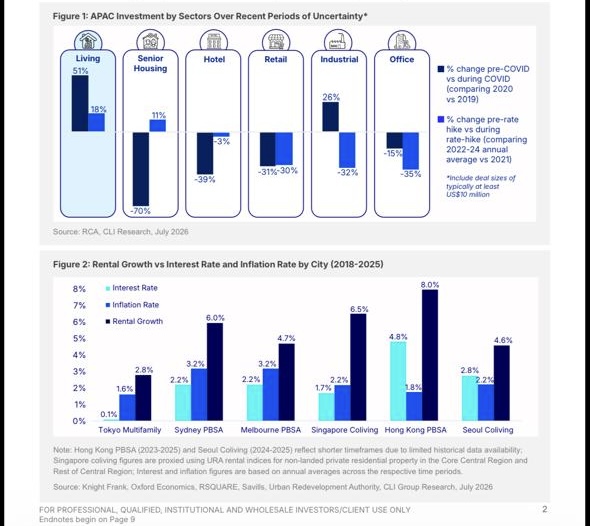
According to CapitaLand Investment’s latest report, APAC Flexible Living: Achieving Scalable Growth from Structural Demand, the living sector was the only real estate segment in the region to register investment volume growth during both the Covid-19 pandemic and the subsequent global interest-rate hiking cycle. Investment volumes increased by 51 per cent during the pandemic period and a further 18 per cent during the high-rate environment, highlighting the defensive characteristics of residential rental assets.
The sector’s resilience has been further supported by rental growth that consistently outpaced both inflation and borrowing costs across major APAC markets. This has enabled investors to preserve real income while maintaining a positive spread over financing costs, reinforcing living assets as a compelling income-oriented allocation within diversified real estate portfolios.
Demand Drivers
The report notes that demographic and social shifts continue to reshape housing demand across the region. Shrinking household sizes, the rise of single-person households, urbanisation and increased cross-border mobility are driving sustained demand for rental housing. These trends are unfolding against a backdrop of persistent housing shortages, affordability challenges and rising barriers to homeownership, pushing a growing segment of the population towards professionally managed rental accommodation.
Government policy is also playing an increasingly important role. Immigration initiatives, labour mobility programmes and planning reforms across several APAC markets are boosting population growth while creating a more supportive environment for institutional rental housing. The combination of policy-backed demand growth and constrained housing supply is supporting high occupancy levels, improving rental visibility and creating favourable conditions for long-term income resilience.
However, the report cautions that structural demand is no longer enough to differentiate investors. While demographic tailwinds and policy reforms are expanding the addressable market, excess returns will increasingly depend on how effectively investors acquire, operate and scale living assets.
Diverse Markets
A key takeaway from the report is that there is no single APAC living strategy. The region’s living sector remains highly fragmented, with each market following a distinct institutionalisation pathway and offering different risk-return profiles.
Japan remains the region’s most mature living market, where direct acquisition of stabilised multifamily assets continues to dominate investment activity due to the sector’s depth, transparency and liquidity.
In contrast, Australia’s purpose-built student accommodation (PBSA) and coliving sectors present opportunities across both ground-up development and adaptive reuse projects. Singapore’s coliving market is largely driven by conversion and adaptive reuse strategies, while Hong Kong’s PBSA segment has emerged as one of the region’s most conversion-led opportunities following regulatory reforms.
Meanwhile, South Korea remains in the early stages of institutionalisation, creating opportunities for investors to establish operating platforms, sourcing networks and market presence ahead of broader sector maturity.
Operational Edge
As the sector evolves, operational expertise is emerging as a key differentiator. Revenue management, product positioning, active asset management and local market knowledge are increasingly influencing asset performance and investment returns.
The report highlights that regional operating platforms can create significant competitive advantages by enhancing sourcing capabilities, standardising design and procurement processes, optimising pricing strategies and improving operational efficiencies. Scale also provides investors with greater flexibility around capital recycling and exit strategies, enabling them to maximise value creation over the investment lifecycle.
For the architecture, planning and development community, the findings underscore a growing shift towards adaptive reuse, mixed-use integration and purpose-built living environments that respond to changing demographic patterns and evolving urban lifestyles. As APAC’s housing landscape continues to transform, the ability to design, operate and scale flexible living solutions is set to become a defining factor in the next phase of real estate growth.