



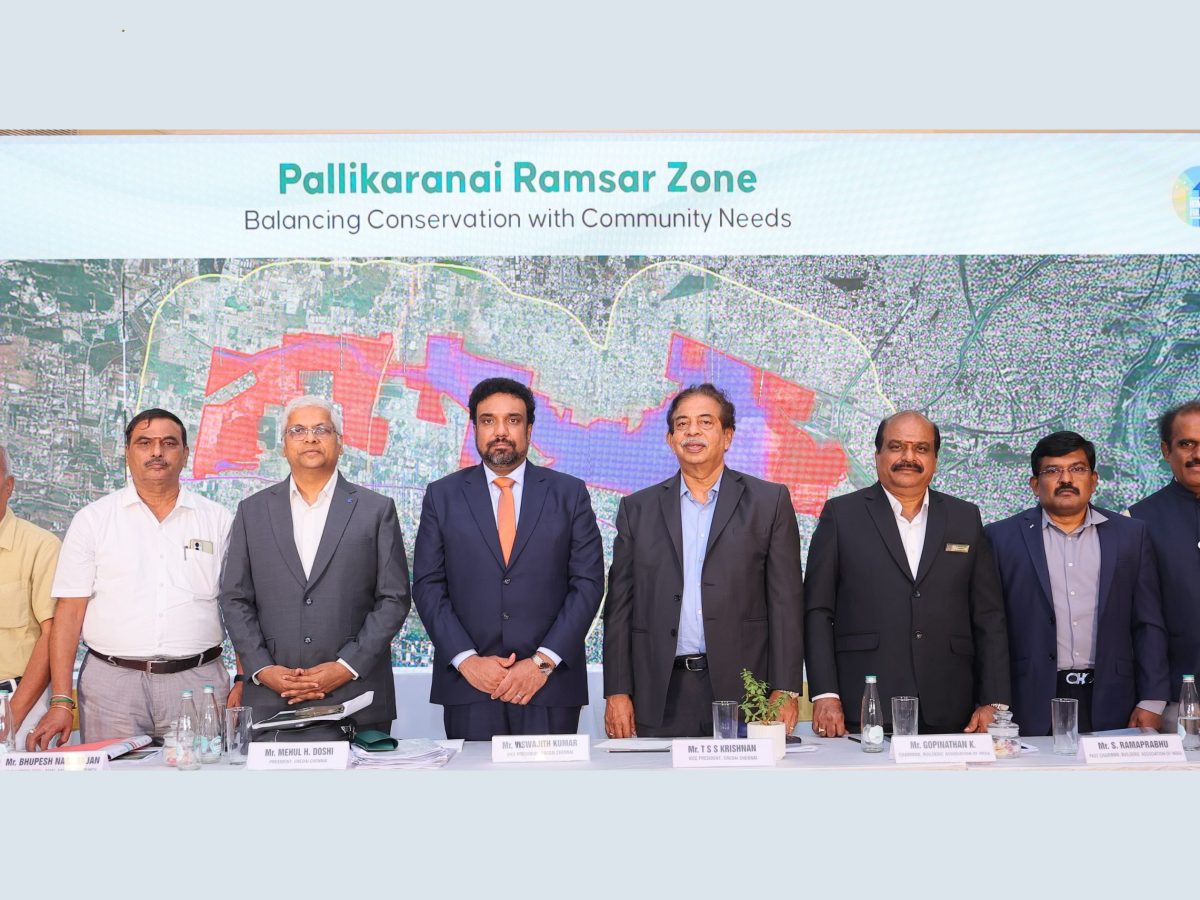
Chennai’s real estate industry has urged the Tamil Nadu government to adopt a scientific and consultative approach to development regulations around the Pallikaranai Ramsar Wetland, citing concerns over a uniform 1-km development freeze that it says has affected more than one lakh patta landowners and stalled significant economic activity.
Industry bodies, including CREDAI Chennai, builders’ associations and flat promoters’ associations, contend that the current restrictions stem from the inclusion of an additional 550 hectares in the Ramsar site without completing ground-truthing, survey number demarcation, public consultation or statutory notification as required under the Wetlands (Conservation and Management) Rules.
According to industry estimates, the planning restrictions have impacted projects and business activity worth ₹51,735.88 crore, with the overall direct and indirect economic impact estimated at nearly ₹19,790 crore. Earlier assessments had placed the combined business and economic value affected at around ₹71,500 crore. The industry also warned that thousands of jobs linked to construction, MSMEs, suppliers, transport, and allied services could be affected.
The real estate sector has argued that the wetland’s zone of influence should be determined only after the exact extent of the protected area is scientifically identified. It has called for hydrological studies, digital elevation modelling, drainage analysis, field verification and survey-based mapping before development restrictions are finalised. Industry representatives also cited the East Kolkata Wetlands, where no blanket buffer zone has been prescribed despite the area’s urban context.
Developers further pointed out that the notified zone includes existing residential neighbourhoods, educational institutions, hospitals, public utilities, Chennai Metro Rail Phase II stations, MRTS infrastructure and the proposed Sholinganallur transit hub, making it an integral part of Chennai’s urban fabric.
The industry has requested the government to temporarily withdraw the uniform 1-km planning freeze, complete the statutory Integrated Management Plan through scientific studies and public consultation, and allow planning approvals, project renewals, no-objection certificates and housing loans to continue until the final wetland boundaries and influence zone are officially notified.
The appeal underscores the challenge of balancing wetland conservation with sustainable urban development, with stakeholders advocating for regulations that protect ecologically sensitive areas while ensuring clarity and certainty for property owners, infrastructure projects and future investments.