



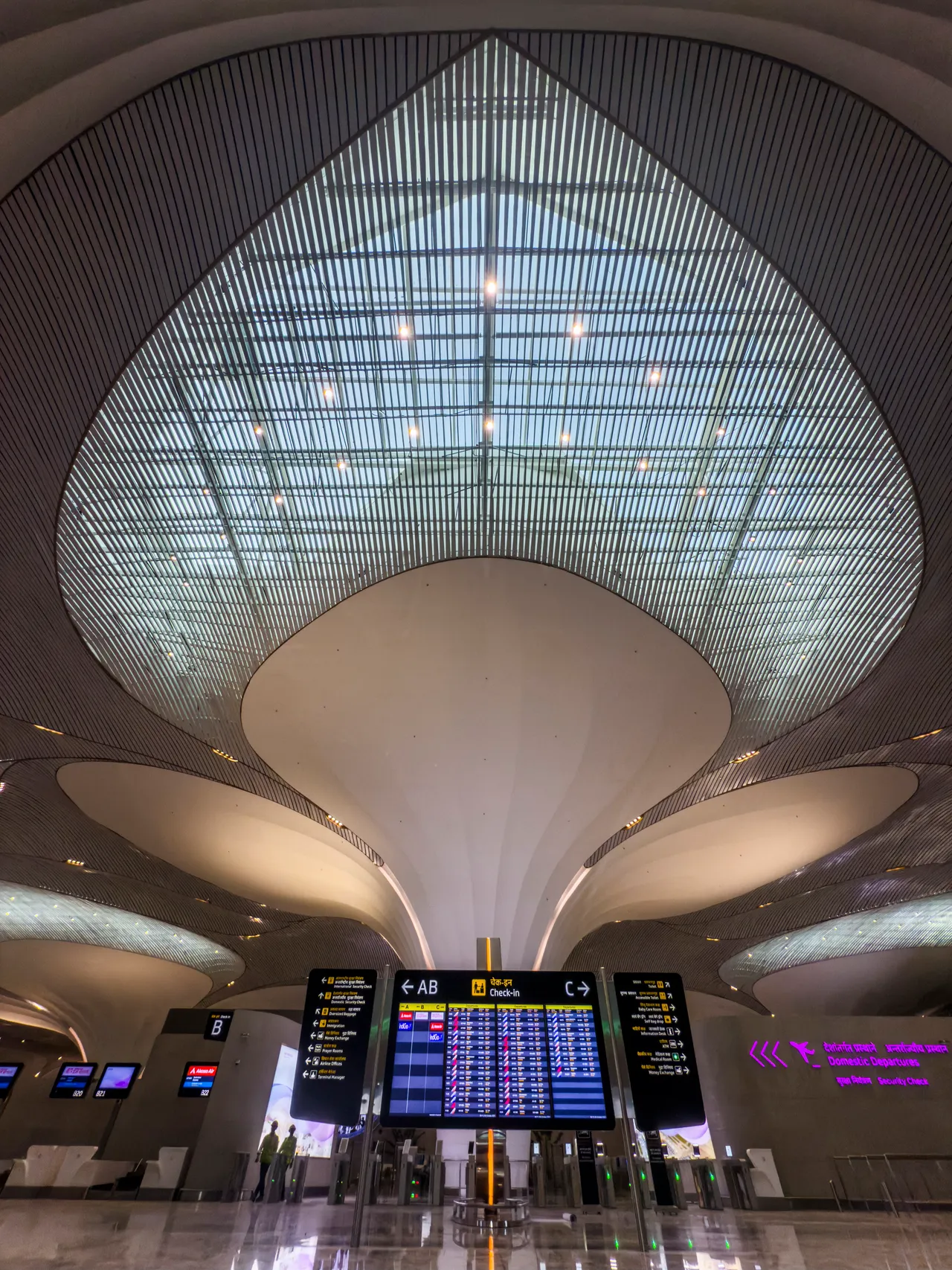
The new Navi Mumbai International Airport (NMIA) terminal, designed by Zaha Hadid Architects (ZHA), is being hailed as one of India’s most ambitious infrastructure projects — a fusion of cutting-edge engineering, sustainable planning, and cultural symbolism.
Estimated at INR19,650 crore, the airport marks ZHA’s largest commission in India and among its most complex globally. Awarded in 2018 after an international design competition, the project includes Terminal 1, the Air Traffic Control Tower, and key landside infrastructure.
The terminal’s design draws inspiration from the Indian lotus, reinterpreting the flower’s concentric geometry into a structural and environmental system. The roof unfolds in petal-like shells that manage daylight, wind, and drainage — crucial in a region defined by monsoon rains, seismic activity, and high passenger growth. The central atrium, shaped as a symbolic pond, forms the heart of the passenger concourse.
ZHA has translated the lotus motif into a digitally modelled, modular structure, balancing sculptural form with buildability. Each roof segment is fabricated in steel and reinforced concrete, assembled on-site using precision alignment systems to maintain geometric consistency across the 370-metre-long terminal span.
A distinctive feature is the two-tier column structure: twelve sculptural “petal” columns channel natural light and create spatial rhythm, while seventeen mega-columns carry the structural load, ensuring resilience against wind and seismic stresses.
Beyond its visual drama, NMIA’s design embodies cultural continuity and modern engineering. The columned halls and filtered light echo the grandeur of traditional Indian mandapas, while glass-and-steel construction situates it firmly in the global architectural present.
Natural light plays a central role in the terminal’s environmental strategy. Skylights and vertical light wells maximise illumination and minimise energy use, aligning with sustainability goals.
Conceived as a modular system, NMIA will grow in phases. Phase 1, now nearing completion, is designed to handle 20 million passengers annually, scalable to 90 million with future expansions and a second runway.
By blending cultural identity with architectural innovation, NMIA positions Navi Mumbai as a new gateway to India’s global connectivity — and sets a benchmark for future-ready, climate-conscious airport design in Asia.

