



London Museum Smithfield is set to open in the restored Victorian General Market ahead of its long-awaited launch, following the permanent closure of the original Museum of London building at London Wall in December 2022. Despite community claims to preserve the modernist building, demolition plans for the brutalist landmark were approved in 2024 to make way for the London Wall West redevelopment project. The institution was then officially rebranded as the London Museum and relocated to the historic General Market in Smithfield. The decade-long restoration project of the new location was carried out by Stanton Williams and Asif Khan, alongside conservation architect Julian Harrap. The official opening of the Museum’s new permanent galleries is scheduled for November 28, 2026.
Victorian Market Revival
Developed through a partnership between the City of London Corporation, the Mayor of London, and philanthropic supporters, the restoration of the Victorian General Market is returning the disused historic building to public use for the first time in over three decades. The building is located in one of the capital’s oldest parts, in an area that has been a centre for trade and exchange for almost a millennium. The area has been a former home to Shakespeare and a backdrop to the works of Charles Dickens, and today counts around 600 listed buildings, 28 conservation areas, 48 scheduled ancient monuments and four historic parks and gardens. The Market was designed by Sir Horace Jones and opened in 1883. It was closed to the public in the 1990s, and fell into disrepair. London Museum Smithfield now reclaims this heritage site for the city.
Stanton Williams, Asif Khan, and Julian Harrap are now transforming it into a 21st-century cultural destination, preserving the building’s heritage as a working market by drawing on expertise from over 70 trades. From English heritage coppersmiths to master stonemasons and Welsh blacksmiths restoring decorative ironwork, the project has brought together craftspeople from various fields. Heritage rediscoveries include an 800 square metre system of vaults beneath London’s streets and a perimeter of heritage shopfronts. The team of professionals is working to combine heritage with future-proofed sustainability measures, from toilets powered by rainwater to renewable geothermal energy and an eco-concrete mix. London Museum Smithfield integrates these systems throughout the site.
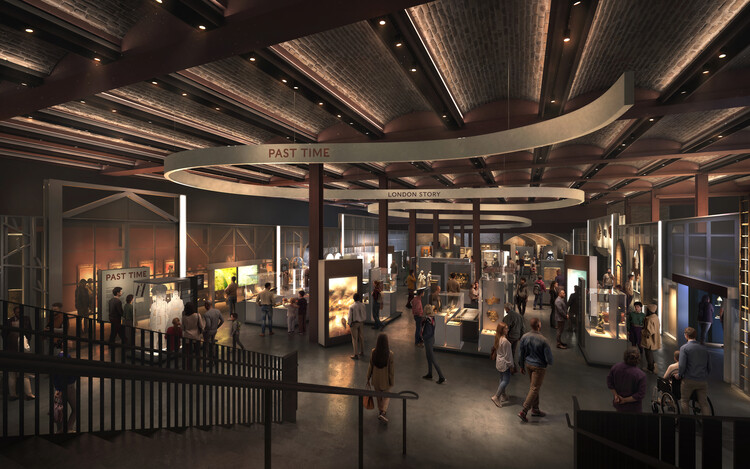
Envisioned as a social space, the new London Museum Smithfield is arranged into three interconnected spaces. The entrance is via “Real Time,” a covered former street that acts as the museum’s main entrance. Then visitors move into “Our Time,” a central hub for events and activities anchored by 13 large installations—eclectic objects from London. Below ground, in the museum’s subterranean galleries, is the third space called “Past Time,” where permanent displays offer an overview of London’s history. Exhibited highlights range from Banksy’s Piranhas artwork to objects from the museum’s eminent archaeological archive, including Roman writing tablets.
Three Connected Experiences
Our Time event space is at the center of the Museum, in the Linbury Hall beneath the market’s restored dome. The space includes a restaurant, shop, and a show space, around the 13 installations meant to be eclectic snapshots of London. The area hosts a day-to-night program of events, delivered with local entertainment and culinary partners. The activities will be open to the general public, including workshops, live performances, a Dinner Club, a monthly House Party, Playdates for families, Sensory storytelling, and performances bringing to life historical events. London Museum Smithfield positions Our Time as the civic heart of the new institution.
Below the ground, at Roman street level, Past Time houses the museum’s permanent galleries, ranging from the lives of the earliest prehistoric inhabitants and rare artefacts from the city’s Roman origins, to transformative events including the Great Fire and the Blitz, and cultural milestones like the London 2012 Olympic and Paralympic Games. The objects will be displayed both chronologically and thematically for the first time, also exploring the city’s history as an epicentre of protest and activism, and as a global creative powerhouse. Amongst displays, a six-metre viewing window will offer visitors the view of live trains rumbling through the galleries as passengers peer in from the passing Thameslink line. London Museum Smithfield uses this connection to embed the museum in the city’s living infrastructure.
Globally, similar cultural projects are advancing. In Denmark, the ARoS Aarhus Art Museum has unveiled As Seen Below – The Dome, a new Skyspace by the artist James Turrell that completes the museum’s 4,000-square-metre underground expansion designed by Schmidt Hammer Lassen. The Tallinn Architecture Biennale is reopening a partially abandoned multipurpose sports venue to host its upcoming edition, while the Spanish urban festival Concéntrico creates temporary spaces to experience art and reflect on architecture throughout the city of Logroño. In China, the Songshan Lake Exhibition and Performance Center, designed by Zaha Hadid Architects in collaboration with the Beijing Institute of Architectural Design, recently opened its doors, as well as Shamballa, an 8-hectare open-air laboratory and research site in Italy dedicated to sustainable living and advanced architectural 3D printing. London Museum Smithfield joins this international wave of adaptive reuse and cultural investment.
Image Courtesy: ArchDaily

